Advertisements
Advertisements
प्रश्न
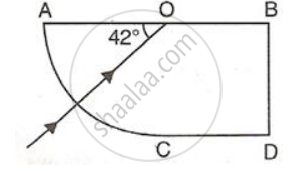
A ray of light enters a glass slab ABDC as shown in figure and strikes at the centre O of the circular part AC of the slab. The critical angle of glass is 42°. Complete the path of the ray till it emerges out from the slab. Mark the angles in the diagram wherever necessary.
Advertisements
उत्तर
Inside the slab at K ∠i = 48° = ∠r
KL incident ray strikes at L, ∠i = 42° = ∠C and emergent ray LM is parallel to BD, i.e. ∠r = 90°

APPEARS IN
संबंधित प्रश्न
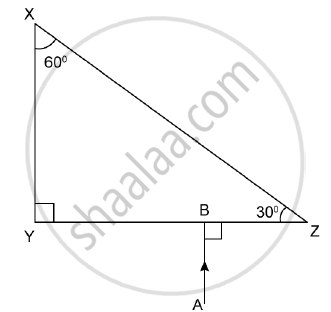
The following diagram shows a 60°, 30°, 90° glass prism of critical angle 42°, Copy the diagram and complete the path of incident ray AB emerging out of the prism marking the angle of incidence on each surface.
How does the angle of minimum deviation produces by a prism change with increase in :
the refracting angle of prism?
A total reflecting right angled isosceles prism can be used to deviate a ray of light through:
(a) 30° (b) 60° (c) 75° (d) 90°.
Rahim recorded the following sets of observations while tracing the path of a ray of light passing through a rectangular glass slab for different angles of incidence.
|
S. No. |
Angle of incidence |
Angle of refraction |
Angle of emergence |
|
I |
45° |
41° |
45° |
|
II |
40° |
38° |
38° |
|
III |
45° |
41° |
40° |
|
IV |
41° |
45° |
41° |
The correct observation is recorded at serial number:
(1) I
(2) II
(3) III
(4) IV
What is the correct reason for blinking / flickering of stars? Explain it.
a) The blasts in the stars.
b) Absorption of star light by the atmosphere.
c) Motion of the stars.
d) Changing refractive index of gases in the atmosphere.
Name one main factor on which the direction of bending of a ray of light depends.
Comment on the statement ‘The refractive index of glass is 3/2.’
