Advertisements
Advertisements
Question
How will you verify the laws of refraction or how the refractive index of glass is determined in the laboratory?
Advertisements
Solution
Place a white sheet of paper on a drawing board. Put a rectangular slab of glass on this white sheet and trace out its boundary ABCD. At any point R on the edge AB, draw a normal NN’. Draw an incident ray PR at any angle say 30°. Fix two pins P1 and P2 vertically on the line PR and at a distance not less than 3 cm from each other. Looking through the other side of the block, fix two pins, P3 and P4 vertically on the white sheet, such that all the four pins P1, P2, P3, and P4 appear to be in a straight line as seen through the glass block. Mark the pinpoints with a fine pencil, remove the block and join the points P3 and P4 by the straight line RS.
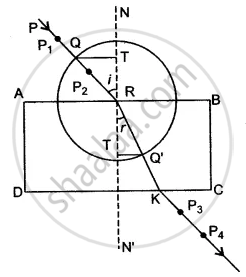
PR represents the incident ray and RS represents the refracted ray. ∠PRN and ∠KRN’ are respectively angles of incidence and refraction.
With R as centre and convenient radius, draw a circle cutting the incident ray at Q and the refracted ray at Q’.
From Q and Q’, draw perpendiculars QT and QT’ on the normal NN’
Now sin i = `"QT"/"QR"`
and Sin r = `"Q’T’"/"Q’T’"`
μ = `Sin"i"/Sin"r"="QT"/"QR"."Q’R"/"Q’T’"="QT"/"Q’T’"`
Since QR = Q’R being the radius of the same circle.
Repeat this experiment for other angles of incidence, say 45° and 60°, and find μ.
It is found that for different values of i the ratio.
`sin"i"/Sin"r"` = constant
Thus, it is verified that,
(i) `sin"i"/Sin"r"` is a constant and is equal to aμg.
(ii) The incident the refracted ray and normal line in the same plane.
RELATED QUESTIONS
If the speed of light in vacuum is 3 × 10⁸ ms−1, find the speed of light in a medium of absolute refractive index 1.5.
Observe the following figure and answer the questions given under it:

1) How many times does refraction take place in the above figure?
2) What happens to the ray of light when it passes from air to glass?
3) What happens to the ray of light when it passes from glass to air?
4) What are the rays AB and CD in the figure called?
5) Define refraction.
A ray of light strikes the surface of a rectangular glass block such that the angle of incidence in
air is 0°.
In each case, draw diagram to show the path taken by the ray as it passes through the glass block and emerges from it.
In the adjacent diagram, AO is a ray of light incident on a rectangular glass slab.

- Complete the path of the ray till it emerges out of the slab.
- In the diagram, mark the angle of incidence (i) and the angle of refraction (r) at the first interface. How is the refractive index of glass related to the angles i and r?
- Mark angles of emergence by the letter e. How are the angles i and e related?
- Which two rays are parallel to each other? Name them.
- Indicate in the diagram the lateral displacement between the emergent ray and the incident ray. State one factor that affects the lateral displacement.
How is the angle of emergence related to the angle of incidence when prism is in the position of minimum deviation? Illustrate your answer with help of a labelled diagram using an equilateral prism?
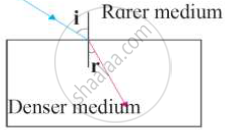
Observe the figure and write accurate conclusion regarding refraction of light.
(i) What is the relation between the refractive index of water with respect to air `("_aμ_\text(w))` and the refractive index of air with respect to water `("_\text(w)μ_ a)` .
(ii) If the refractive index of water with respect to air `("_aμ_\text(w))` is`5/3`. Calculate the refractive index of air with respect to water `("_\text(w)μ_ a)` .
Draw an í- `delta` graph for a mono chromatic raY through a glass prism of a plane and mark
(i) `delta` m, the angle of mínimum devíation
(íí) Any two values of i for which value of `delta` ís same.
Glass is transparent in nature. Why does glass powder look opaque? When water is poured over it, it again becomes transparent. Why?
In the diagram alongside a ray of light, PQ is incident normally on one face AB of an equilateral glass prism. What is the angle of incidence at the faces AB and AC?

