Advertisements
Advertisements
Question
During sunset and sunrise, the sun is seen when it is slightly below the horizon. Give reason.
Advertisements
Solution
Light rays from the sun while coming towards earth suffers successive refractions from a rarer to a denser medium and so it bends towards the normal at each refraction. These rays on earth appear to be coming from an apparent position of the sun which is higher than its actual position. Thus, the sun is seen even when it is slightly below the horizon during sunset and sunrise.
RELATED QUESTIONS
Name one factor that affects the lateral displacement of light as it passes through a rectangular glass slab.
How does the angle of minimum deviation produces by a prism change with increase in :
the wavelength of incident light
Complete Fig. 4.32 to show the path of the ray of single colour as it enters the prism and emerges out of it. Mark the angles wherever necessary.
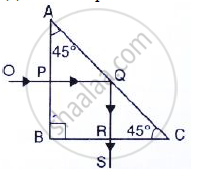
A ray of light OP passes through a right angles prism as shown in the adjacent diagram.
(a) State the angles of incidence at the faces AC and BC.
(b) Name the phenomenon which the ray suffers at the face AC.
A ray of light strikes the surface at a rectangular glass slab such that the angle of incidence is 45o.
In each case, draw diagram to show the path taken by the ray as it passes through the glass slab and emerges from it.
Can the absolute refractive index of a medium be less than one?
Name two instruments of the total refracting prism in which is used.
The diagram shows the path of a ray of light through a rectangular glass block placed in a liquid of uniform density.

What is the angular, deviation of the emergent ray from the glass block with respect to the incident ray?
Write the approximate values of speed of light in (i) air and (ii) glass. Use these values to calculate the refractive index of glass with respect to air.
