Advertisements
Advertisements
प्रश्न
Fig shows a lens as a combination of a glass block and two prisms.
(i) Name the lens formed by the combination.
(ii) What is the line XX' called?
(iii) Complete the path of the incident ray PQ after passing through the lens.
(iv) The final emergent ray either meets XX' at a point or appears to come from a point on XX'. Label it as F, What is this point called?
Advertisements
उत्तर
(i) Concave lens.
(ii) The line XX' called the principal axis.
(iii)

(iv) The final emergent ray will appear to meet XX' at a point called its second focus of the lens.
APPEARS IN
संबंधित प्रश्न
A student traces the path of a ray of light passing through a rectangular glass slab and marks the angle of incidence i, angle of refraction r and angle of emergence e, as shown.
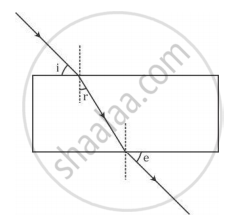
The correctly marked angle(s) is/are
(A) ∠ i only
(B) ∠ e only
(C) ∠ r only
(D) ∠ i and ∠ e
Select from the following the best experimental setup for tracing the path of a ray of light passing through a rectangular glass slab.
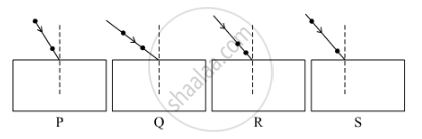
(a) P
(b) Q
(c) R
(d) S
The highest refractive index is of ______.
The refractive index of air with respect to glass is expressed as `""_g μ_a=sin i /sin r`.
- Write down a similar expression for aμg in terms of the angles i and r.
- If angle r = 90°, what is the corresponding angle i called?
- What is the physical significance of the angle i in part (b)?
Fig shows a lens as a combination of a glass block and two prisms.
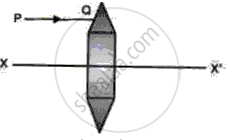
(i) Name the lens formed by the combination.
(ii) what is the XX' called?
(iii) Complete the ray diagram and show the path of the incident ray PQ after passing through the lens.
(iv) The final emergent ray will either meet XX' at a point or appear to come from a point on XX'. what is the point called?
Draw ray of light bending towards the normal while passing from air to glass. Label your diagrams.
Draw ray of light bending towards the normal while passing from glass to water. Label your diagrams.
Complete the ray diagram showing its emergence into the air after passing through the prism.

Two parallel rays of Red and Violet travelling through the air, meet the air-glass boundary as shown in the above figure. Will their paths inside the glass be parallel? Give a reason for your answer.

A ray of light strikes the surface of a rectangular glass slab such that the angle of incidence in air is
- 0°,
- 45°.
In each case, draw a diagram to show the path taken by the ray as it passes through the glass slab and emerges from it.
