Advertisements
Advertisements
Question
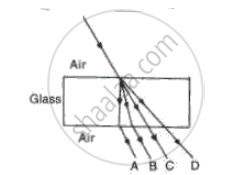
In the fig. name the ray which represents the correct path of light while passing through a glass block.
Advertisements
Solution
The correct path is that of ray 'B'.
APPEARS IN
RELATED QUESTIONS
A student traces the path of a ray of light passing through a rectangular glass slab and marks the angle of incidence i, angle of refraction r and angle of emergence e, as shown.
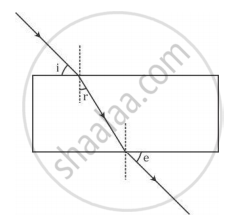
The correctly marked angle(s) is/are
(A) ∠ i only
(B) ∠ e only
(C) ∠ r only
(D) ∠ i and ∠ e
Draw diagrams to show the refraction of light from glass to air. In diagram, label the incident ray, refracted ray, the angle of incidence (i) and the angle of refraction (r).
How does the angle of minimum deviation produces by a prism change with increase in :
the refracting angle of prism?
What do you understand by the statement the refractive index of glass is 1.5 for white light?
A coin is places at the bottom of a beaker containing water (refractive index = 4/3) to a depth of 12 cm. By what height the coin appears to be raised when seen from vertically above?
Which of the following is the best experimental set-up out of the four shown for tracing the path of a ray of light passing through a rectangular glass slab ?
The critical angle for glass-air interface is :
A ray of monochromatic light is incident from air into a glass slab. Draw a labelled ray diagram indicating the change in its path till it emerges out of the slab. In the diagram, mark the angle of incidence (i) and the angle of refraction (r) at the first interface. How is the refractive index of glass related to the angles i and r?
Draw ray of light bending towards the normal while passing from air to glass. Label your diagrams.
Observe the figure and name the ray AB, ray CD, ray GH.

