Advertisements
Advertisements
Question
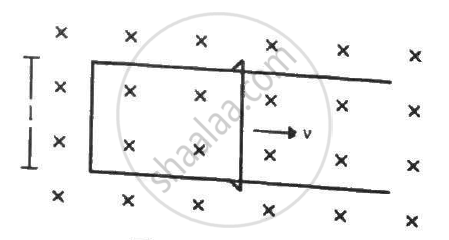
Figure shows a long U-shaped wire of width l placed in a perpendicular magnetic field B. A wire of length l is slid on the U-shaped wire with a constant velocity v towards right. The resistance of all the wires is r per unit length. At t = 0, the sliding wire is close to the left edge of the U-shaped wire. (a) Calculate the force needed to keep the sliding wire moving with a constant velocity v. (b) If the force needed just after t = 0 is F0, find the time at which the force needed will be F0/2.0
Advertisements
Solution
Emf induced in the circuit, e = Bvl
Current in the circuit,
\[i = \frac{e}{R} = \frac{Bvl}{2r(l + vt)}\]
(a) Force F needed to keep the sliding wire moving with a constant velocity v will be equal in magnitude to the magnetic force on it. The direction of force F will be along the direction of motion of the sliding wire.
Thus, the magnitude of force F is given by
\[F = ilB = \frac{Bvl}{2r(l + vt)} \times lB\]
\[ = \frac{B^2 l^2 v}{2r(l + vt)}\]
(b) The magnitude of force F at t = 0 is given by
\[F_0 = ilB = lB\left( \frac{lBv}{2rl} \right) \]
\[ = \frac{l B^2 v}{2r} .............(1)\]
Let at time t = T, the value of the force be F0/2.
Now,
\[\frac{F_0}{2} = \frac{l^2 B^2 v}{2r(l + vT)}\]
On substituting the value of F0 from (1), we get
\[\frac{l B^2 v}{4r} = \frac{l^2 B^2 v}{2r(l + vT)}\]
\[ \Rightarrow 2l = l + vT\]
\[ \Rightarrow T = \frac{l}{v}\]
APPEARS IN
RELATED QUESTIONS
The magnetic flux through a loop varies according to the relation Φ = 8t2 + 6t + C, where ‘C’ is constant, 'Φ' is in milliweber and 't' is in second. What is the magnitude of induced e.m.f. in the loop at t = 2 seconds.
State three differences between direct current and alternating current.
A metal rod `1/sqrtpi `m long rotates about one of its ends perpendicular to a plane whose magnetic induction is 4 x 10⁻³ T. Calculate the number of revolutions made by the rod per second if the e.m.f. induced between the ends of the rod is 16 mV.
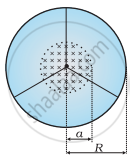
A line charge λ per unit length is lodged uniformly onto the rim of a wheel of mass M and radius R. The wheel has light non-conducting spokes and is free to rotate without friction about its axis (Figure). A uniform magnetic field extends over a circular region within the rim. It is given by,
B = − B0 k (r ≤ a; a < R)
= 0 (otherwise)
What is the angular velocity of the wheel after the field is suddenly switched off?
A circular coil of cross-sectional area 200 cm2 and 20 turns is rotated about the vertical diameter with angular speed of 50 rad s−1 in a uniform magnetic field of magnitude 3.0 × 10⁻²T. Calculate the maximum value of the current in the coil.
An emf of 2V is induced in a coil when the current in it is changed from 0A to 10A in 0·40 sec. Find the coefficient of self-inductance of the coil.
How does an electromagnet differ forma permanent magnet?
Welders wear special goggles or face masks with glass windows to protect their eyes from electromagnetic radiations. Name the radiations and write the range of their frequency.
Electromagnetic induction means ______.
The coil of a moving-coil galvanometer keeps on oscillating for a long time if it is deflected and released. If the ends of the coil are connected together, the oscillation stops at once. Explain.
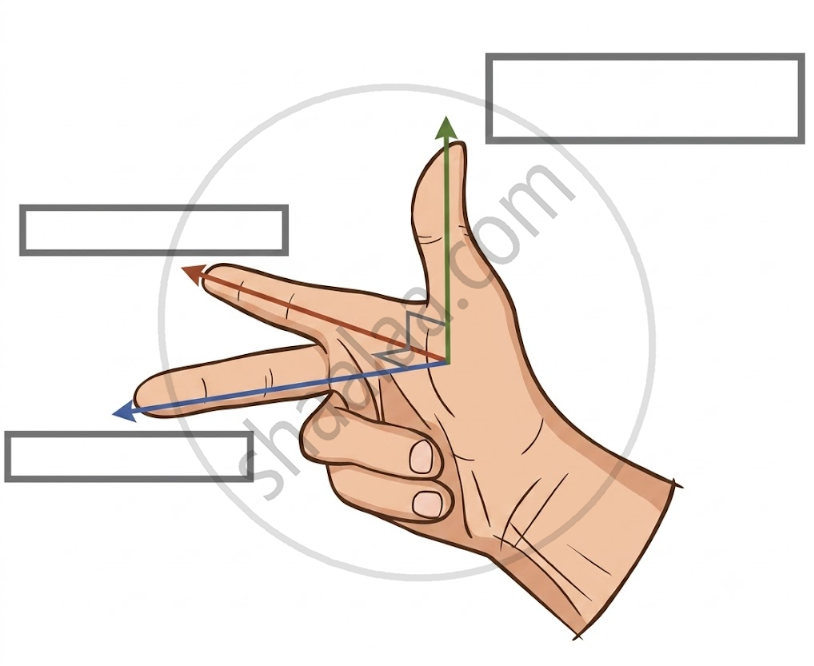
State Fleming’s Right Hand Rule.
Draw a labelled diagram to show how an electromagnet is made.
Write the two names in the following diagram.
Fleming’s right hand rule.
A closely wound circular coil of radius 0.02 m is placed perpendicular to the magnetic field. When the magnetic field is changed from 8000 T to 2000 T in 6 s, an emf of 44 V is induced in it. Calculate the number of turns in the coil.
A cylindrical bar magnet (A) and similar unmagnetized cylindrical iron bar (B) are dropped through metallic pipe. The time taken to come down by ____________.
A conductor of length 50 cm carrying a current of 5 A is placed perpendicular to a magnetic field of induction 2×10 -3T. Find the force on the conductor.
A sheet is placed on horizontal surface in front of a strong magnetic pole. A force is needed to:
- hold the sheet there if it is magnetic.
- hold the sheet there if it is non-magnetic.
- move the sheet away from the pole with uniform velocity if it is conducting.
- move the sheet away from the pole with uniform velocity if it is both, non-conducting and nonpolar.
Choose the correct statement(s) from the options given below:
What is produced when a magnet moves towards or away from a coil?
What is a coil?
Which device used for producing electricity works on electromagnetic induction?
