Advertisements
Advertisements
Questions
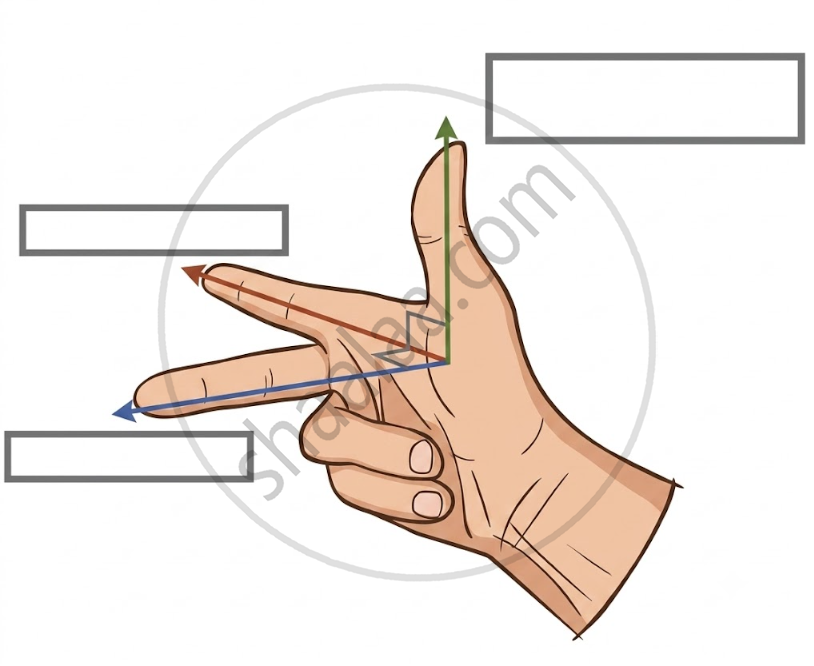
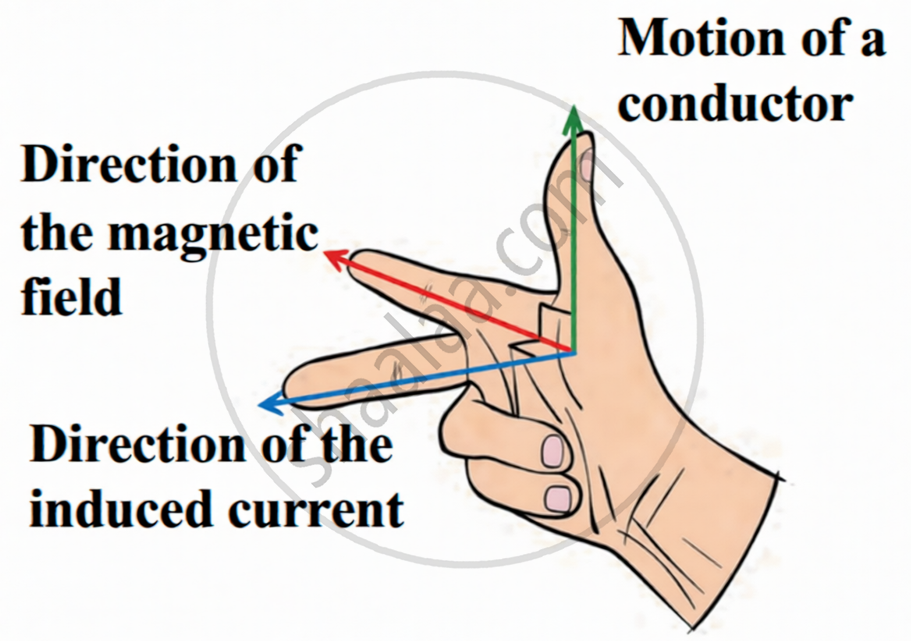
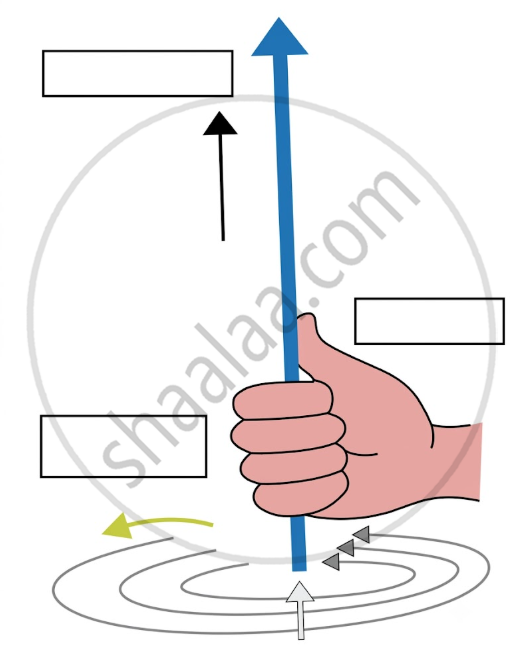
Write the two names in the following diagram.
Fleming’s right hand rule.
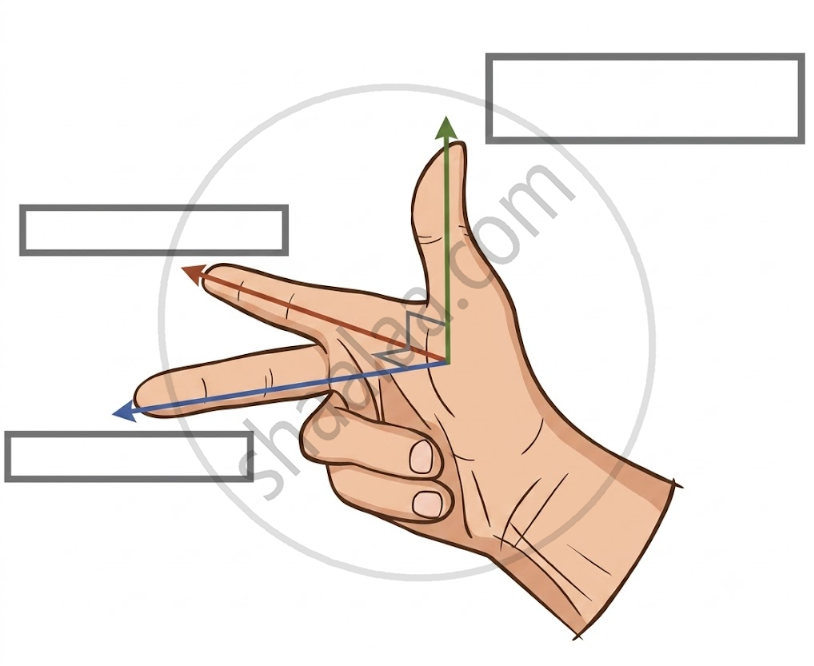
Label the following diagram.
Fleming’s right-hand rule.
Advertisements
Solution
APPEARS IN
RELATED QUESTIONS
The magnetic flux through a loop varies according to the relation Φ = 8t2 + 6t + C, where ‘C’ is constant, 'Φ' is in milliweber and 't' is in second. What is the magnitude of induced e.m.f. in the loop at t = 2 seconds.
State Fleming’s right-hand rule.
When a bar magnet is pushed towards (or away) from the coil connected to a galvanometer, the pointer in the galvanometer deflects. Identify the phenomenon causing this deflection and write the factors on which the amount and direction of the deflection depends. State the laws describing this phenomenon.
Explain different ways to induce current in a coil.
The phenomenon of electromagnetic induction is
It is desired to measure the magnitude of field between the poles of a powerful loud speaker magnet. A small flat search coil of area 2 cm2 with 25 closely wound turns, is positioned normal to the field direction, and then quickly snatched out of the field region. Equivalently, one can give it a quick 90° turn to bring its plane parallel to the field direction. The total charge flown in the coil (measured by a ballistic galvanometer connected to coil) is 7.5 mC. The combined resistance of the coil and the galvanometer is 0.50 Ω. Estimate the field strength of magnet.
Name a common device that uses electromagnets.
How does an electromagnet differ forma permanent magnet?
The most suitable material for making the core of an electromagnet is:
(a) soft iron
(b) brass
(c) aluminium
(d) steel
State whether the following statement are true or false:
A motor works on the principle electric generator?
Name one device which works on the phenomenon of electromagnetic induction.
Welders wear special glass goggles while working. Why? Explain.
The coil of a moving-coil galvanometer keeps on oscillating for a long time if it is deflected and released. If the ends of the coil are connected together, the oscillation stops at once. Explain.
A conducting rod is moved with a constant velocity v in a magnetic field. A potential difference appears across the two ends _____________ .
L, C and R represent the physical quantities inductance, capacitance and resistance respectively. Which of the following combinations have dimensions of frequency?
(a) `1/(RC)`
(b) `R/L`
(c) `1/sqrt(LC)`
(d) C/L
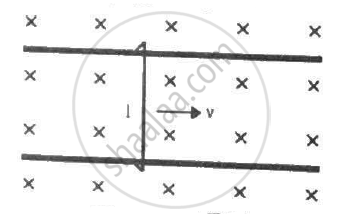
Figure shows a wire sliding on two parallel, conducting rails placed at a separation l. A magnetic field B exists in a direction perpendicular to the plane of the rails. What force is necessary to keep the wire moving at a constant velocity v?
A transformer has 400 turns in the primary winding and 10 turns in the secondary winding. The primary e.m.f. is 250 V and the primary current is 2.0 A. calculate:
(a) The secondary voltage,
(b) The secondary current, assuming 100% efficiency.
Answer the following:
State the principles of the electric motor and electric generator.
Draw a labelled diagram to show how an electromagnet is made.
What is an electromagnet? What do you know about the simplest form of an electromagnet?
State the condition at which we say the two coils kept close to each other are perfectly coupled with each other.
The right-hand thumb rule is also called _______ rule.
Write the two names in the following diagram.
Right hand thumb rule.
Obtain an expression for motional emf from Lorentz force.
A square coil of side 30 cm with 500 turns is kept in a uniform magnetic field of 0.4 T. The plane of the coil is inclined at an angle of 30° to the field. Calculate the magnetic flux through the coil.
The magnetic flux passing through a coil perpendicular to its plane is a function of time and is given by OB = (2t3 + 4t2 + 8t + 8) Wb. If the resistance of the coil is 5 Ω, determine the induced current through the coil at a time t = 3 second.
A coil of 200 turns carries a current of 0.4 A. If the magnetic flux of 4 mWb is linked with each turn of the coil, find the inductance of the coil.
There is a uniform magnetic field directed perpendicular and into the plane of the paper. An irregular shaped conducting loop is slowly changing into a circular loop in the plane of the paper. Then ______.
A metal plate can be heated by ______.
What should be the core of an electromagnet?
Which of the following phenomena makes use of electromagnetic induction?
In the given circuit, initially switch S1 is closed and S2 and S3 are open. After charging of capacitor, at t = 0, S1 is open and S2 and S3 are closed. If the relation between inductance capacitance and resistance is L = 4CR2 then the time (in sec) after which current passing through capacitor and inductor will be same is ______ × 10-4 N. (Given R = ℓn(2)mΩ, L = 2mH)

When an electric current is passed through a wire or a coil, a magnetic field is produced. Is the reverse phenomenon possible i.e, can a magnetic field produce an electric current? Explain with the help of an appropriate example.
Which scientists established in the early nineteenth century that electricity and magnetism are related?
Around 1830, who showed that an electric current can be induced in a closed coil exposed to a changing magnetic field?
What is a changing magnetic field?
