Advertisements
Advertisements
Question
A conducting rod is moved with a constant velocity v in a magnetic field. A potential difference appears across the two ends _____________ .
Options
if `vec v " || "vec l`
if `vec v " || "vec B`
if `vec l " || "vec B`
None of these
Advertisements
Solution
None of these
The potential difference across the two ends is given by
`e=Bvl`
It is non-zero only
(i) if the rod is moving in the direction perpendicular to the magnetic field `(vec v bot vec B)`
(ii) if the velocity of the rod is in the direction perpendicular to the length of the rod `(vec v bot vec l)`
(iii) if the magnetic field is perpendicular to the length of the rod `vec l bot vec B`
Thus, none of the above conditions is satisfied in the alternatives given.
APPEARS IN
RELATED QUESTIONS
The phenomenon of electromagnetic induction is
How does an electromagnet differ forma permanent magnet?
Name two devices in which electromagnets are used and two devices where permanent magnets are used.
The direction of current in the coil at one end of an electromagnet is clockwise. This end of the electromagnet will be:
(a) north pole
(b) east pole
(c) south pole
(d) west pole
Name one device which works on the phenomenon of electromagnetic induction.
Electromagnetic induction means ______.
A conducting square loop having edges of length 2.0 cm is rotated through 180° about a diagonal in 0.20 s. A magnetic field B exists in the region which is perpendicular to the loop in its initial position. If the average induced emf during the rotation is 20 mV, find the magnitude of the magnetic field.
Fig. shows a simple form of an A.C. generator.
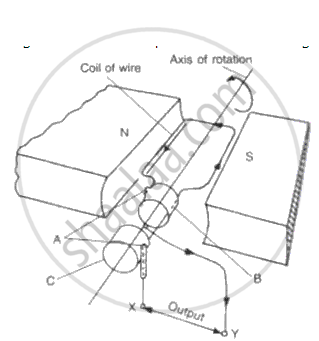
(a) Name the parts labeled A and B.
(b) What would be the effect of doubling the number of turns on the coil if the speed of rotation remains unchanged?
(c) Which of the output terminals is positive if the coil is rotating in the
direction shown in the diagram (anticlockwise)?
( d ) What is the position of the rotating coil when p.d. across its ends is zero? Explain why p.d. is zero when the coil is at this position .
(e) Sketch a graph showing how the p.d. across the ends of the rotating coil varies with time for an A.C. dynamo.
( f) On th e same sheet of paper and vertically below the first graph using the same time scale, sketch graphs to show the effect of
(i) Doubling the speed of rotation and at the same time keeping
the field and the number of turns constant,
(ii ) Doubling the number of turns on the coil and at the same time
doubling the speed of rotation of the coil, keeping th e speed
constant.
A coil has a self-inductance of 0·05 Henry. Find the magnitude of the emf induced in it when the current flowing through it is changing at the rate of 100 As-1.
What is an electromagnet?
List some of the practical applications of an electromagnet.
The diagram shows a rectangular coil ABCD, suspended freely between the concave pole pieces of a permanent horseshoe magnet, such that the plane of the coil is parallel to the magnetic field.
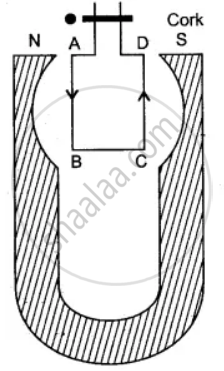
- State your observation when the current is switched on.
- Give an explanation for your observation in (i).
- State the rule, which will help you to find the motion of rotation of the coil.
- In which position will the coil ultimately come to rest?
- State four ways of increasing the magnitude of force acting on the coil.
A cylindrical bar magnet (A) and similar unmagnetized cylindrical iron bar (B) are dropped through metallic pipe. The time taken to come down by ____________.
A coil of one turn is made of a wire of certain length and then from the same length, a coil of two turns is made. If the same current is passed in both the cases, then the ratio of the magnetic inductions at their centres will be:
AB is a coil of copper wire having a large number of turns. The ends of the coil are connected with a galvanometer as shown. When the north pole of a strong bar magnet is moved towards end B of the coil, a deflection is observed in the galvanometer.

- State the reason for using galvanometer in the activity and why does its needle deflects momentarily when magnet is moved towards the coil.
- What would be observed in the galvanometer in a situation when the coil and the bar magnet both move with the same speed in the same direction? Justify your answer.
- State the conclusion that can be drawn from this activity.
Will there be any change in the momentary deflection in the galvanometer if number of turns in the coil is increased and a more stronger magnet is moved towards the coil?
OR
What is electromagnetic induction? What is observed in the galvanometer when a strong bar magnet is held stationary near one end of a coil of large number of turns? Justify your answer.
Which type of force is experienced by a moving charge in a magnetic field?
How were electricity and magnetism considered for a long time?
