Advertisements
Advertisements
प्रश्न
Answer the following:
State the principles of the electric motor and electric generator.
Advertisements
उत्तर
- Principle of electric motor:
Electric motor works on the principle that a current carrying conductor placed in a magnetic field experiences a force. - Principle of electric generator:
Electric generator works on the principle of electromagnetic induction. When the coil of electric generator rotates in a magnetic field. The magnetic field induces a current in this coil. This induced current then flows into circuit connected to the coil.
APPEARS IN
संबंधित प्रश्न
State three differences between direct current and alternating current.
Explain different ways to induce current in a coil.
Two circular coils A and B are placed closed to each other. If the current in the coil A is changed, will some current be induced in the coil B? Give reason.
A horizontal straight wire 10 m long extending from east to west is falling with a speed of 5.0 m s−1, at right angles to the horizontal component of the earth’s magnetic field, 0.30 × 10⁻⁴ Wb m−2.
- What is the instantaneous value of the emf induced in the wire?
- What is the direction of the emf?
- Which end of the wire is at the higher electrical potential?
A circular coil of cross-sectional area 200 cm2 and 20 turns is rotated about the vertical diameter with angular speed of 50 rad s−1 in a uniform magnetic field of magnitude 3.0 × 10⁻²T. Calculate the maximum value of the current in the coil.
State the factors on which the strength of an electromagnet depends. How does it depend on these factors?
What condition is necessary for the production of current by electromagnetic induction?
When a wire is moved up and down in a magnetic field, a current is induced in the wire. What is this phenomenon known as?
Describe different ways to induce current in a coil of wire.
Welders wear special glass goggles while working. Why? Explain.
Welders wear special goggles or face masks with glass windows to protect their eyes from electromagnetic radiations. Name the radiations and write the range of their frequency.
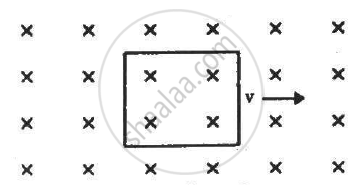
A conducting square loop of side l and resistance R moves in its plane with a uniform velocity v perpendicular to one of its sides. A uniform and constant magnetic field Bexists along the perpendicular to the plane of the loop as shown in figure. The current induced in the loop is _____________ .
Fill in the blanks by writing (i) Only soft iron, (ii) Only steel, (iii) Both soft-iron and steel for the material of core and/or magnet.
D.C. motor ______.
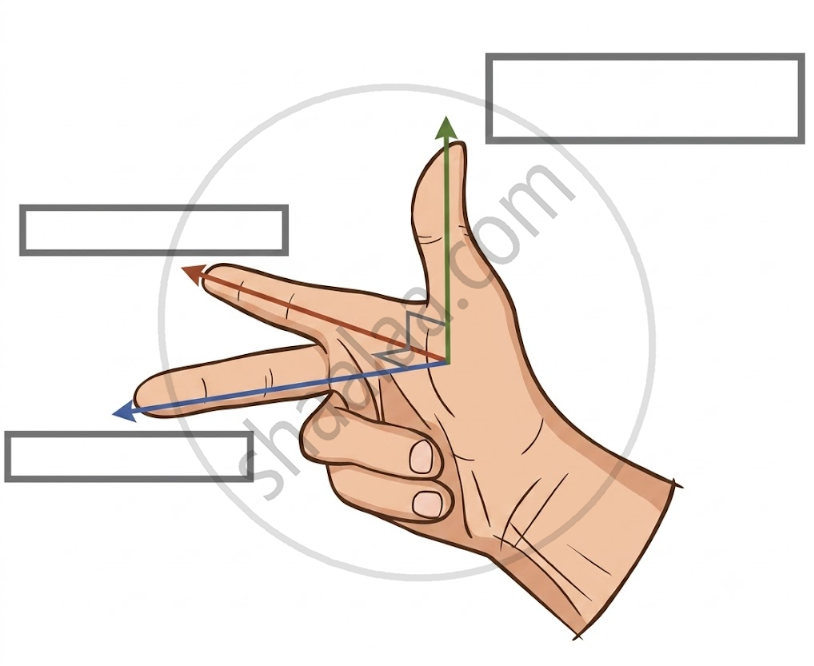
State Fleming’s Right Hand Rule.
State the purpose of soft iron core used in making an electromagnet.
Draw a labelled diagram to make an electromagnet from a soft iron bar. Mark the polarity at its ends in your diagram. What precaution would you observe while making it?
Write the two names in the following diagram.
Fleming’s right hand rule.
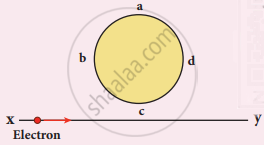
An electron moves on a straight-line path XY as shown in the figure. The coil abcd is adjacent to the path of the electron. What will be the direction of the current, if any, induced in the coil?
A thin semi-circular conducting ring (PQR) of radius r is falling with its plane vertical in a horizontal magnetic field B, as shown in the figure.
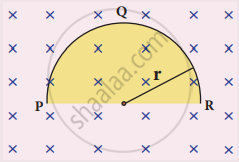
The potential difference developed across the ring when its speed v , is
A 50 cm long solenoid has 400 turns per cm. The diameter of the solenoid is 0.04 m. Find the magnetic flux linked with each turn when it carries a current of 1 A.
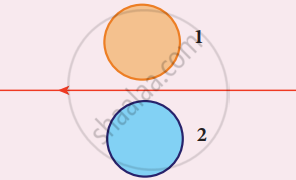
Using Lenz’s law, predict the direction of induced current in conducting rings 1 and 2 when the current in the wire is steadily decreasing.
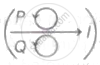
Metal rings P and Q are lying in the same plane, where current I is increasing steadily. The induced current in metal rings is shown correctly in figure.
A metal plate can be heated by ______.
What should be the core of an electromagnet?
Name some equipment that uses electromagnetism for functioning.
For making a strong electromagnet the material of the core should be ______.
Sea turtles return to their birth beach many decades after they were born due to ______.
A 0.4 m wire, stretched horizontally, carries an electric current of 15 A, in a magnetic field whose magnetic field intensity is 0.1 N/Am. What is the magnitude of the wire?
In the given circuit, initially switch S1 is closed and S2 and S3 are open. After charging of capacitor, at t = 0, S1 is open and S2 and S3 are closed. If the relation between inductance capacitance and resistance is L = 4CR2 then the time (in sec) after which current passing through capacitor and inductor will be same is ______ × 10-4 N. (Given R = ℓn(2)mΩ, L = 2mH)

Which type of force is experienced by a moving charge in a magnetic field?
What can produce a current in a coil even when the coil does not move?
Which movement of a coil can produce a current?
What is a solenoid?
Which type of motor works on electromagnetic induction?
