Advertisements
Advertisements
प्रश्न
Answer the following:
State the principles of the electric motor and electric generator.
Advertisements
उत्तर
- Principle of electric motor:
Electric motor works on the principle that a current carrying conductor placed in a magnetic field experiences a force. - Principle of electric generator:
Electric generator works on the principle of electromagnetic induction. When the coil of electric generator rotates in a magnetic field. The magnetic field induces a current in this coil. This induced current then flows into circuit connected to the coil.
APPEARS IN
संबंधित प्रश्न
Two circular coils A and B are placed closed to each other. If the current in the coil A is changed, will some current be induced in the coil B? Give reason.
A rectangular wire loop of sides 8 cm and 2 cm with a small cut is moving out of a region of uniform magnetic field of magnitude 0.3 T directed normal to the loop. What is the emf developed across the cut if the velocity of the loop is 1 cm s−1 in a direction normal to the
- longer side,
- shorter side of the loop?
For how long does the induced voltage last in each case?
What is electromagnetic induction?
State three ways in which the strength of an electromagnet can be increased.
State the factors on which the strength of an electromagnet depends. How does it depend on these factors?
State whether the following statement are true or false:
A generator works on the principle of electromagnetic induction.
When a wire is moved up and down in a magnetic field, a current is induced in the wire. What is this phenomenon known as?
What do you understand by the term "electromagnetic induction"? Explain with the help of a diagram.
Describe one experiment to demonstrate the phenomenon of electromagnetic induction.
In which of the following case does the electromagnetic induction occur?
The current is stopped in a wire held near a loop of wire .
When Puja, a student of 10th class, watched her mother washing clothes in the open, she observed coloured soap bubbles and was curious to know why the soap bubbles appear coloured. In the evening when her father, an engineer by profession, came home, she asked him this question. Her father explained to her the basic phenomenon of physics due to which the soap bubbles appear coloured.
(a) What according to you are the values displayed by Puja and her father?
(b) State the phenomenon of light involved in the formation of coloured soap bubbles.
Welders wear special goggles or face masks with glass windows to protect their eyes from electromagnetic radiations. Name the radiations and write the range of their frequency.
Consider the energy density in a solenoid at its centre and that near its ends. Which of the two is greater?
A conducting rod is moved with a constant velocity v in a magnetic field. A potential difference appears across the two ends _____________ .
Can a transformer work when it is connected to a D.C. source? Give a reason.
Fill in the blanks by writing (i) Only soft iron, (ii) Only steel, (iii) Both soft-iron and steel for the material of core and/or magnet.
D.C. motor ______.
Fill in the blanks by writing (i) Only soft iron, (ii) Only steel, (iii) Both soft-iron and steel for the material of core and/or magnet.
A. C. generator______.
Name the following diagram and explain the concept behind it.
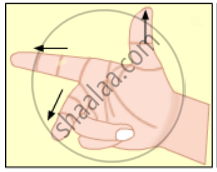
What is an electromagnet? What do you know about the simplest form of an electromagnet?
Draw a labelled diagram to make an electromagnet from a soft iron bar. Mark the polarity at its ends in your diagram. What precaution would you observe while making it?
The energy stored in a 50 mH inductor carrying a current of 4 A is ______
Write the two names in the following diagram.
Right hand thumb rule.
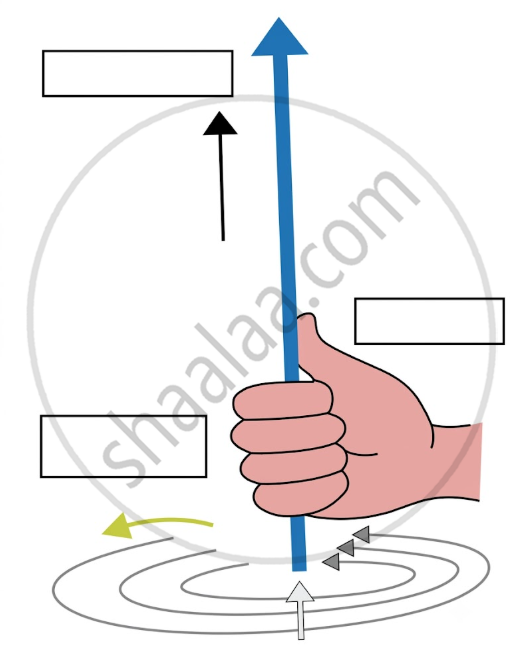
A straight metal wire crosses a magnetic field of flux 4 mWb in a time 0.4 s. Find the magnitude of the emf induced in the wire.
A coil of 200 turns carries a current of 4 A. If the magnetic flux through the coil is 6 x 10⁻⁵ Wb, find the magnetic energy stored in the medium surrounding the coil.
The condition for the praenomen of electromagnetic induction is that there must be a relative motion between ____________.
What should be the core of an electromagnet?
Induced current flows through a coil ______.
The working of a dynamo is based on the principle of
AB is a coil of copper wire having a large number of turns. The ends of the coil are connected with a galvanometer as shown. When the north pole of a strong bar magnet is moved towards end B of the coil, a deflection is observed in the galvanometer.

- State the reason for using galvanometer in the activity and why does its needle deflects momentarily when magnet is moved towards the coil.
- What would be observed in the galvanometer in a situation when the coil and the bar magnet both move with the same speed in the same direction? Justify your answer.
- State the conclusion that can be drawn from this activity.
Will there be any change in the momentary deflection in the galvanometer if number of turns in the coil is increased and a more stronger magnet is moved towards the coil?
OR
What is electromagnetic induction? What is observed in the galvanometer when a strong bar magnet is held stationary near one end of a coil of large number of turns? Justify your answer.
A current I = 10 sin(100π t) A is passed in first coil, which induces a maximum e.m.f of 5π volt in second coil. The mutual inductance between the coils is ______.
The primary of a transformer has 400 turns while the secondary has 2000 turns. If the power output from the secondary at 1000 Vis 12 kW, what is the primary voltage?
Show that for a given positive ion species in a cyclotron, (i) the radius of their circular path inside a dee is directly proportional to their speed, and (ii) the maximum ion energy achievable is directly proportional to the square of the magnetic induction.
Which movement of a coil can produce a current?
What did Faraday show in 1831?
What is a solenoid?
What is a changing magnetic field?
