Advertisements
Advertisements
प्रश्न
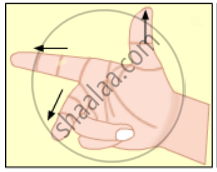
State Fleming’s Right Hand Rule.
Advertisements
उत्तर

- Stretch the thumb, forefinger and middle finger of the right hand so that they are perpendicular to each other.
- If the forefinger indicates the direction of the magnetic field and the thumb shows the direction of the motion of the conductor, then the middle finger will show the direction of the induced current.
- The induced current is found to be the maximum when the direction of motion of the coil is at right angles to the magnetic field.
APPEARS IN
संबंधित प्रश्न
Electric field intensity in free space at a distance ‘r’ outside the charged conducting sphere of radius ‘R’ in terms of surface charge density ‘ a ’ is............................
(a)`sigma / in_0[R/r]^2`
(b)`in_0/sigma[R/r]^2`
(c)`R/r[sigma/in_0]^2`
(d)`R/sigma[r/in_0]^2`
State Fleming’s right-hand rule.
A metal rod `1/sqrtpi `m long rotates about one of its ends perpendicular to a plane whose magnetic induction is 4 x 10⁻³ T. Calculate the number of revolutions made by the rod per second if the e.m.f. induced between the ends of the rod is 16 mV.
Explain different ways to induce current in a coil.
The phenomenon of electromagnetic induction is
Two circular coils A and B are placed closed to each other. If the current in the coil A is changed, will some current be induced in the coil B? Give reason.
When an electric current is passed through any wire, a magnetic field is produced around it. Then why an electric iron connecting cable does not attract nearby iron objects when electric current switched on through it?
State three ways in which the strength of an electromagnet can be increased.
Name two devices in which electromagnets are used and two devices where permanent magnets are used.
Write some of the important uses of electromagnets.
An induced current is produced when a magnet is moved into a coil. The magnitude of induced current does not depend on:
(a) the speed with which the magnet is moved
(b) the number of turns of the coil
(c) the resistivity of the wire of the coil
(d) the strength of the magnet
L, C and R represent the physical quantities inductance, capacitance and resistance respectively. Which of the following combinations have dimensions of frequency?
(a) `1/(RC)`
(b) `R/L`
(c) `1/sqrt(LC)`
(d) C/L
Draw a simple labeled diagram of a step-down transformer.
Fill in the blanks by writing (i) Only soft iron, (ii) Only steel, (iii) Both soft-iron and steel for the material of core and/or magnet.
D.C. motor ______.
Name the following diagram and explain the concept behind it.
A coil has a self-inductance of 0·05 Henry. Find the magnitude of the emf induced in it when the current flowing through it is changing at the rate of 100 As-1.
What is an electromagnet? What do you know about the simplest form of an electromagnet?
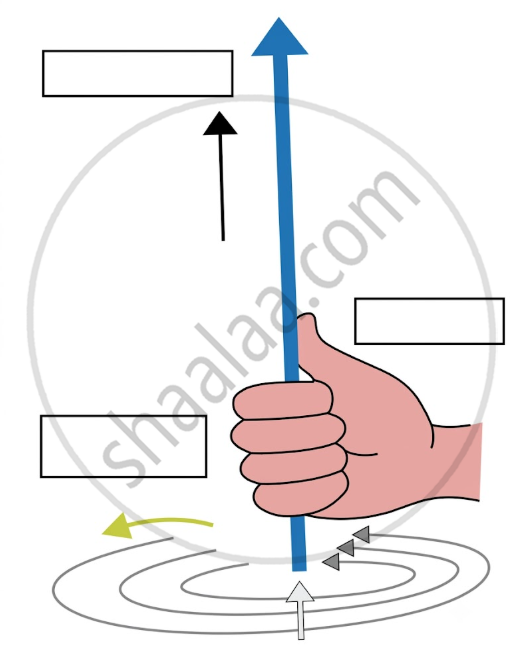
The right-hand thumb rule is also called _______ rule.
Fleming's left hand rule : electric current : : Fleming's right hand rule : _______
Write the two names in the following diagram.
Right hand thumb rule.
Show that Lenz’s law is in accordance with the law of conservation of energy.
A straight metal wire crosses a magnetic field of flux 4 mWb in a time 0.4 s. Find the magnitude of the emf induced in the wire.
Shown in the figure below is a metre bridge set up with null deflection in the galvanometer. The value of the unknown resistance R is ______

A cylindrical bar magnet is kept along the axis of a circular coil. If the magnet is rotated about its axis, then ____________.
A cylindrical bar magnet (A) and similar unmagnetized cylindrical iron bar (B) are dropped through metallic pipe. The time taken to come down by ____________.
There is a uniform magnetic field directed perpendicular and into the plane of the paper. An irregular shaped conducting loop is slowly changing into a circular loop in the plane of the paper. Then ______.
A metal plate can be heated by ______.
We can induce the current in a coil by ____________.
Ansari Sir was demonstrating an experiment in his class with the setup as shown in the figure below.

A magnet is attached to a spring. The magnet can go in and out of the stationary coil. He lifted the Magnet and released it to make it oscillate through the coil.
Based on your understanding of the phenomenon, answer the following question.
What is the principle which Ansari Sir is trying to demonstrate?
Name some equipment that uses electromagnetism for functioning.
The working of a dynamo is based on the principle of
Which type of force is experienced by a moving charge in a magnetic field?
A sheet is placed on horizontal surface in front of a strong magnetic pole. A force is needed to:
- hold the sheet there if it is magnetic.
- hold the sheet there if it is non-magnetic.
- move the sheet away from the pole with uniform velocity if it is conducting.
- move the sheet away from the pole with uniform velocity if it is both, non-conducting and nonpolar.
Choose the correct statement(s) from the options given below:
Which movement can change the number of magnetic field lines passing through a coil near a solenoid?
What is a changing magnetic field?
Which device used for using electricity developed from Faraday’s and Henry’s experiments?
