Advertisements
Advertisements
प्रश्न
A bar magnet is moved along the axis of a copper ring placed far away from the magnet. Looking from the side of the magnet, an anticlockwise current is found to be induced in the ring. Which of the following may be true?
(a) The south pole faces the ring and the magnet moves towards it.
(b) The north pole faces the ring and the magnet moves towards it.
(c) The south pole faces the ring and the magnet moves away from it.
(d) The north pole faces the ring and the magnet moves away from it.
Advertisements
उत्तर
(b) The north pole faces the ring and the magnet moves towards it.
(c) The south pole faces the ring and the magnet moves away from it.
It can be observed that the induced current is in anti-clockwise direction. So, the magnetic field induced in the copper ring is towards the observer.
According to Lenz's law, the current induced in a circuit due to a change in the magnetic flux is in such direction so as to oppose the change in flux.
Two cases are possible:-
(1) The magnetic flux is increasing in the direction from the observer to the circular coil.
(2) The magnetic flux is decreasing in the direction from the coil to the observer.
So, from the above mentioned points, the following conclusions can be made:-
1. The south pole faces the ring and the magnet moves away from it.
2. The north pole faces the ring and the magnet moves towards it.
APPEARS IN
संबंधित प्रश्न
Show that Lenz's law is a consequence of conservation of energy.
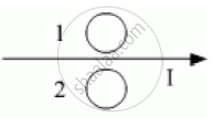
Predict the directions of induced currents in metal rings 1 and 2 lying in the same plane where current I in the wire is increasing steadily.
A short magnet is moved along the axis of a conducting loop. Show that the loop repels the magnet if the magnet is approaching the loop and attracts the magnet if it is going away from the loop.
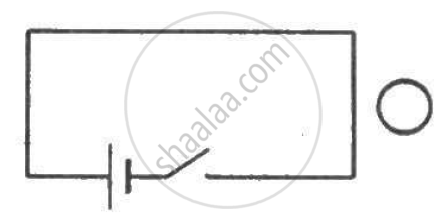
Consider the situation shown in figure. If the switch is closed and after some time it is opened again, the closed loop will show ____________ .
Explain, with the help of a suitable example, how we can show that Lenz's law is a consequence of the principle of conservation of energy.
Young's modulus for aluminium is 7 × 10¹⁰ Pa. The force needed to stretch an aluminium wire of diameter 2 mm and length 800 mm by 1 mm is ______.
A bar magnet is dropped through a copper ring acceleration of magnet is
A wire in the form of a tightly wound solenoid is connected to a DC source, and carries a current. If the coil is stretched so that there are gaps between successive elements of the spiral coil, will the current increase or decrease? Explain.
A solenoid is connected to a battery so that a steady current flows through it. If an iron core is inserted into the solenoid, will the current increase or decrease? Explain.
A metallic ring of mass m and radius `l` (ring being horizontal) is falling under gravity in a region having a magnetic field. If z is the vertical direction, the z-component of magnetic field is Bz = Bo (1 + λz). If R is the resistance of the ring and if the ring falls with a velocity v, find the energy lost in the resistance. If the ring has reached a constant velocity, use the conservation of energy to determine v in terms of m, B, λ and acceleration due to gravity g.
Predict the direction of induced current in the situation described by the following figure.

Predict the direction of induced current in the situation described by the following figure.
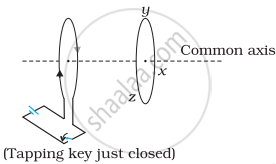
What is observed when the magnet is held stationary near the coil?
What would happen to the magnet if an induced South pole attracted an approaching N-pole without external effort?
How does an induced field oppose a decrease in magnetic flux?
What happens as the rate of change of magnetic flux becomes greater?
For a triangular loop leaving an out-of-page magnetic field, what is the induced current direction and path?
