Advertisements
Advertisements
प्रश्न
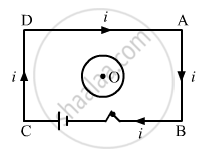
Consider the situation shown in figure. If the switch is closed and after some time it is opened again, the closed loop will show ____________ .
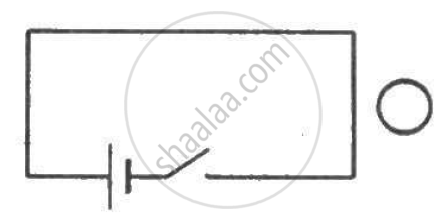
पर्याय
an anticlockwise current-pulse
a clockwise current-pulse
an anticlockwise current-pulse and then a clockwise current-pulse
a clockwise current-pulse and then an anticlockwise current-pulse
Advertisements
उत्तर
a clockwise current-pulse and then an anticlockwise current-pulse
When the switch is closed, the current will flow in downward direction in part AB of the circuit nearest to the closed loop.
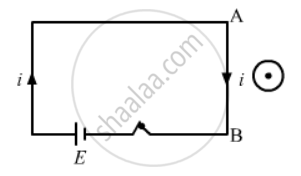
Due to current in wire AB, a magnetic field will be produced in the loop. This magnetic field due to increasing current will be the cause of the induced current in the closed loop. According to Lenz's law, the induced current is such that it opposes the increase in the magnetic field that induces it. So, the induced current will be in clockwise direction opposing the increase in the magnetic field in upward direction.
Similarly, when the circuit is opened, the current will suddenly fall in the circuit, leading to decrease in the magnetic field in the loop. Again, according to Lenz's law, the induced current is such that it opposes the decrease in the magnetic field. So, the induced current will be in anti-clockwise direction, opposing the decrease in the magnetic field in upward direction.
APPEARS IN
संबंधित प्रश्न
State Lenz's law. Illustrate, by giving an example, how this law helps in predicting the direction of the current in a loop in the presence of a changing magnetic flux.
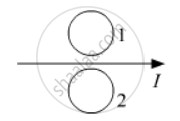
What is the direction of induced currents in metal rings 1 and 2 when current I in the wire is increasing steadily?
Show that Lenz's law is a consequence of conservation of energy.
Predict the directions of induced currents in metal rings 1 and 2 lying in the same plane where current I in the wire is increasing steadily.
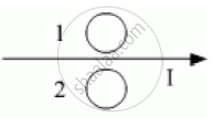
Predict the direction of induced current in metal rings 1 and 2 when current I in the wire is steadily decreasing?
A short magnet is moved along the axis of a conducting loop. Show that the loop repels the magnet if the magnet is approaching the loop and attracts the magnet if it is going away from the loop.
The battery discussed in the previous question is suddenly disconnected. Is a current induced in the other loop? If yes, when does it start and when does it end? Do the loops attract each other or repel?
A bar magnet is released from rest along the axis of a very long, vertical copper tube. After some time the magnet ____________ .
A bar magnet is moved along the axis of a copper ring placed far away from the magnet. Looking from the side of the magnet, an anticlockwise current is found to be induced in the ring. Which of the following may be true?
(a) The south pole faces the ring and the magnet moves towards it.
(b) The north pole faces the ring and the magnet moves towards it.
(c) The south pole faces the ring and the magnet moves away from it.
(d) The north pole faces the ring and the magnet moves away from it.
Consider the situation shown in figure. If the closed loop is completely enclosed in the circuit containing the switch, the closed loop will show _______________ .
Explain, with the help of a suitable example, how we can show that Lenz's law is a consequence of the principle of conservation of energy.
Lenz’s law is a consequence of the law of conservation of ______.
For a coil having L = 2 mH, current flows at the rate of 10-3 AIS. The e.m.f induced is
Lenz's law gives ______
A metallic ring of mass m and radius `l` (ring being horizontal) is falling under gravity in a region having a magnetic field. If z is the vertical direction, the z-component of magnetic field is Bz = Bo (1 + λz). If R is the resistance of the ring and if the ring falls with a velocity v, find the energy lost in the resistance. If the ring has reached a constant velocity, use the conservation of energy to determine v in terms of m, B, λ and acceleration due to gravity g.
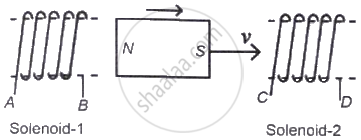
In the diagram given below, a strong bar magnet is moving towards solenoid-2 from solenoid-1. The direction of induced current in solenoid-1 and that in solenoid-2, respectively, are through the directions:
Who formulated Lenz's law in 1834?
Which apparatus is used to observe the induced current when a magnet moves relative to a coil?
When the N-pole moves towards the coil, which induced current direction and near-face pole are observed?
