Advertisements
Advertisements
प्रश्न
Use Lenz’s law to determine the direction of induced current in the situation described by the figure:
A wire of irregular shape turning into a circular shape.

Advertisements
उत्तर

According to Lenz’s law, the direction of the induced emf is such that it tends to produce a current that opposes the change in the magnetic flux that produced it.
A greater area and, by extension, a stronger magnetic flux, are the results of a change in shape. In order to create opposing flux, Lenz's law is used to build up an induced current in the circular wire in an anticlockwise direction. Thus, the upward-directed magnetic field is a result of it.
संबंधित प्रश्न
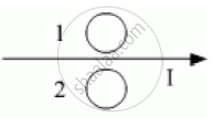
Predict the directions of induced currents in metal rings 1 and 2 lying in the same plane where current I in the wire is increasing steadily.
The battery discussed in the previous question is suddenly disconnected. Is a current induced in the other loop? If yes, when does it start and when does it end? Do the loops attract each other or repel?
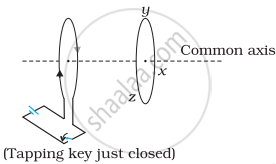
Two circular loops of equal radii are placed coaxially at some separation. The first is cut and a battery is inserted in between to drive a current in it. The current changes slightly because of the variation in resistance with temperature. During this period, the two loops _______________ .
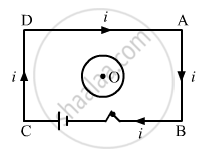
Consider the situation shown in figure. If the closed loop is completely enclosed in the circuit containing the switch, the closed loop will show _______________ .
Lenz’s law is a consequence of the law of conservation of ______.
For a coil having L = 2 mH, current flows at the rate of 10-3 AIS. The e.m.f induced is
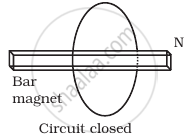
Consider a magnet surrounded by a wire with an on/off switch S (Figure). If the switch is thrown from the off position (open circuit) to the on position (closed circuit), will a current flow in the circuit? Explain.

A long solenoid ‘S’ has ‘n’ turns per meter, with diameter ‘a’. At the centre of this coil we place a smaller coil of ‘N’ turns and diameter ‘b’ (where b < a). If the current in the solenoid increases linearly, with time, what is the induced emf appearing in the smaller coil. Plot graph showing nature of variation in emf, if current varies as a function of mt2 + C.
Predict the direction of induced current in the situation described by the following figure.
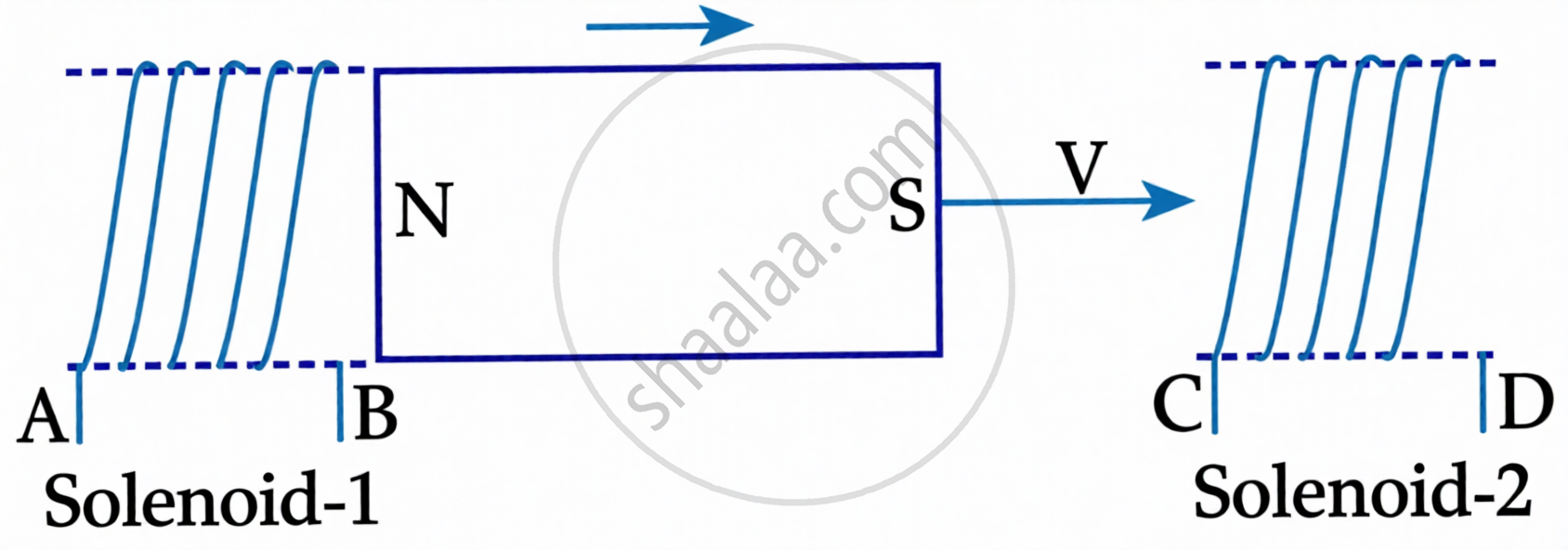
In the above diagram, a strong bar magnet is moving towards solenoid-2 from solenoid-1. The direction of induced current in solenoid-1 and that in solenoid-2, respectively, are through the directions:
In the diagram given below, a strong bar magnet is moving towards solenoid-2 from solenoid-1. The direction of induced current in solenoid-1 and that in solenoid-2, respectively, are through the directions:
Which laws determine the magnitude of an induced EMF?
Which expression incorporates Lenz's law into Faraday's law?
When the N-pole moves towards the coil, which induced current direction and near-face pole are observed?
What does the magnetic pole created on the near face of the coil oppose when a magnet moves?
How does an induced field oppose an increase in magnetic flux?
In what sense does Lenz's law behave like electromagnetic inertia?
For a triangular loop leaving an out-of-page magnetic field, what is the induced current direction and path?
