Advertisements
Advertisements
Question
Use Lenz’s law to determine the direction of induced current in the situation described by the figure:
A wire of irregular shape turning into a circular shape.

Advertisements
Solution

According to Lenz’s law, the direction of the induced emf is such that it tends to produce a current that opposes the change in the magnetic flux that produced it.
A greater area and, by extension, a stronger magnetic flux, are the results of a change in shape. In order to create opposing flux, Lenz's law is used to build up an induced current in the circular wire in an anticlockwise direction. Thus, the upward-directed magnetic field is a result of it.
RELATED QUESTIONS
Predict the direction of induced current in the situation described by the following figure.

Show that Lenz's law is a consequence of conservation of energy.
A bar magnet is moved in the direction indicated by the arrow between two coils PQ and CD. Predict the directions of induced current in each coil.

A short magnet is moved along the axis of a conducting loop. Show that the loop repels the magnet if the magnet is approaching the loop and attracts the magnet if it is going away from the loop.
The battery discussed in the previous question is suddenly disconnected. Is a current induced in the other loop? If yes, when does it start and when does it end? Do the loops attract each other or repel?
A pivoted aluminium bar falls much more slowly through a small region containing a magnetic field than a similar bar of an insulating material. Explain.
A bar magnet is moved along the axis of a copper ring placed far away from the magnet. Looking from the side of the magnet, an anticlockwise current is found to be induced in the ring. Which of the following may be true?
(a) The south pole faces the ring and the magnet moves towards it.
(b) The north pole faces the ring and the magnet moves towards it.
(c) The south pole faces the ring and the magnet moves away from it.
(d) The north pole faces the ring and the magnet moves away from it.
Explain, with the help of a suitable example, how we can show that Lenz's law is a consequence of the principle of conservation of energy.
Which of the following statements is not correct?
2 A 40 kg boy whose legs are 4 cm in area and 50 cm long falls through a height of 2 m without breaking his leg bones. If the bones can withstand stress of 0.9 x 10⁸ N/m2. The Young's modulus for the material of the bone is ______.
Lenz's law gives ______
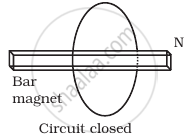
Consider a magnet surrounded by a wire with an on/off switch S (Figure). If the switch is thrown from the off position (open circuit) to the on position (closed circuit), will a current flow in the circuit? Explain.

Consider a metal ring kept on top of a fixed solenoid (say on a carboard) (Figure). The centre of the ring coincides with the axis of the solenoid. If the current is suddenly switched on, the metal ring jumps up. Explain

A conducting wire XY of mass m and neglibile resistance slides smoothly on two parallel conducting wires as shown in figure. The closed circuit has a resistance R due to AC. AB and CD are perfect conductors. There is a ˆ. magnetic field `B = B(t)hatk`.
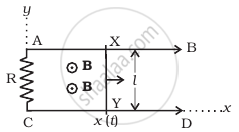
- Write down equation for the acceleration of the wire XY.
- If B is independent of time, obtain v(t) , assuming v(0) = u0.
- For (b), show that the decrease in kinetic energy of XY equals the heat lost in R.
A coil is suspended in a uniform magnetic field, with the plane of the coil parallel to the magnetic lines of force. When a current is passed through the coil it starts oscillating: It is very difficult to stop. But if an aluminium plate is placed near to the coil, it stops. This is due to:
Predict the direction of induced current in the situation described by the following figure.

Predict the direction of induced current in the situation described by the following figure.
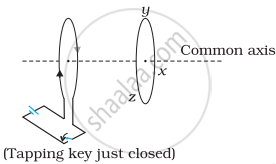
What happens whenever the magnetic flux through a closed circuit changes?
How is Lenz's law related to the Law of Conservation of Energy?
