Advertisements
Advertisements
Question
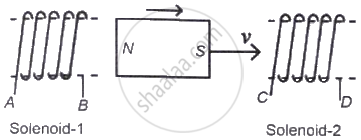
Predict the direction of induced current in the situation described by the following figure.

Advertisements
Solution
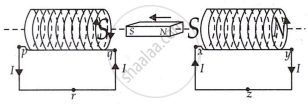
Lenz's law specifies the direction of the induced current in a closed loop. Using Lenz’s rule, the direction of the induced current in the given situation can be predicted as follows:
In accordance with Lenz's law, the left-hand loop experiences current flow in the opposite direction of the right-hand loop.
The direction of the induced current is along prqp.
RELATED QUESTIONS
Describe a simple experiment (or activity) to show that the polarity of emf induced in a coil is always such that it tends to produce a current which opposes the change of magnetic flux that produces it.
Predict the direction of induced current in the situation described by the following figure.

Predict the direction of induced current in a metal ring when the ring is moved towards a straight conductor with constant speed v. The conductor is carrying current I in the direction shown in the figure.
A bar magnet is moved in the direction indicated by the arrow between two coils PQ and CD. Predict the directions of induced current in each coil.

Explain, with the help of a suitable example, how we can show that Lenz's law is a consequence of the principle of conservation of energy.
Which of the following statements is not correct?
For a coil having L = 2 mH, current flows at the rate of 10-3 AIS. The e.m.f induced is
Lenz's law gives ______
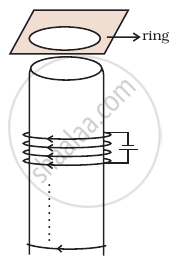
Consider a metal ring kept (supported by a cardboard) on top of a fixed solenoid carrying a current I (Figure). The centre of the ring coincides with the axis of the solenoid. If the current in the solenoid is switched off, what will happen to the ring?
A conducting wire XY of mass m and neglibile resistance slides smoothly on two parallel conducting wires as shown in figure. The closed circuit has a resistance R due to AC. AB and CD are perfect conductors. There is a ˆ. magnetic field `B = B(t)hatk`.
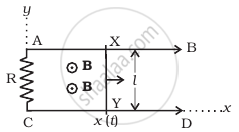
- Write down equation for the acceleration of the wire XY.
- If B is independent of time, obtain v(t) , assuming v(0) = u0.
- For (b), show that the decrease in kinetic energy of XY equals the heat lost in R.
A long solenoid ‘S’ has ‘n’ turns per meter, with diameter ‘a’. At the centre of this coil we place a smaller coil of ‘N’ turns and diameter ‘b’ (where b < a). If the current in the solenoid increases linearly, with time, what is the induced emf appearing in the smaller coil. Plot graph showing nature of variation in emf, if current varies as a function of mt2 + C.
Predict the direction of induced current in the situation described by the following figure.
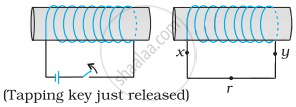
Predict the direction of induced current in the situation described by the following figure.

Use Lenz’s law to determine the direction of induced current in the situation described by the figure.
A circular loop being deformed into a narrow straight wire.

In the diagram given below, a strong bar magnet is moving towards solenoid-2 from solenoid-1. The direction of induced current in solenoid-1 and that in solenoid-2, respectively, are through the directions:
What do Faraday's laws and Lenz's law form together?
How does an induced field oppose an increase in magnetic flux?
