Advertisements
Advertisements
Question
A conducting wire XY of mass m and neglibile resistance slides smoothly on two parallel conducting wires as shown in figure. The closed circuit has a resistance R due to AC. AB and CD are perfect conductors. There is a ˆ. magnetic field `B = B(t)hatk`.
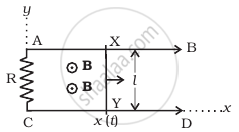
- Write down equation for the acceleration of the wire XY.
- If B is independent of time, obtain v(t) , assuming v(0) = u0.
- For (b), show that the decrease in kinetic energy of XY equals the heat lost in R.
Advertisements
Solution
First we have to analyse the situation as shown in the figure. Let the parallel wires be at y = 0 and y = L and are placed along x-axis. Wire XY is along y-axis.
At t = 0, wire AB starts from x = 0 and moves with a velocity v.
Let at time t, wire is at x(t) = vt. ....(Where x(t) is the displacement as a function of time).
Let us redraw the diagram as shown below.
(i) Let wire XY at t = 0 is at x = 0
And at t = t is at x = x(t)
Magnetic flux is a function of time `phi(t) = B(t) xx A`
∴ `phi(t) = B(t)l.x(t)`
`ε = - (dphi(t))/(dt) = - (dB(t))/(dt)l.x(t) - B(t)l. (dx(t))/(dt)`
`ε = (- dB(t))/(dt) l.x(t) - B(t)lv(t)`
The direction of induced current by Fleming's Right-Hand Rule or by Lenz's law is in clockwise direction in loop XY < AX.
`I = ε/R = (-l)/R [x(t) (dB(t))/(dt) + B(t)v(t)]` ......(I)
The force acting on the conductor is F = B(t) I l sin 90°
F = B(t)I.l
F = `(B(t)lε)/R = (-B(t)l^2)/R [(-dB(t))/(dt).x(t) - B(t).v(t)]`
`(md^2x)/(dt^2) = (-B(t)l^2)/R [x(t) (dB(t))/(dt) + B(t)v(t)]`
Or `(d^2x)/(dt^2) = (-l^2)/(mR) B(t) [x(t) (dB(t))/(dt) + B(t).v(t)]` ......(II)
(ii) Now B is independent of time i.e. B does not change with time or it is constant
∴ `(dB)/(dt)` = 0, B(t) = B and v(t) = c ......(III)
Put (III) in (II) we get
`(d^2x)/(dt^2) = (-l^2)/(mR) [0 + Bv]`
`(d^2x)/(dt^2) + (B^2l^2)/(mR) (dx)/(dt)` = 0
`(dv)/(dt) + (B^2l^2)/(mR) v` = 0
Integrating using variable separable from differential equation we have
`v = A exp((-l^2B^2t)/(mR))`
At t = 0, v = u
∴ `v(t) = u exp ((-l^2B^2t)/(mR))` ......(IV)
(iii) Heat lost per second in (ii) where `(dB)/(dt)` = 0
H = I2R
Magnitude of current from equation I in (i) part
`I = (Blv)/R = (-l)/R [0 + Bv]` ......`[because (dB)/(dt) = 0]`
Heat produced per second H = I2R
∴ `H = (B^2l^2v^2)/R^2 R`
`H = (B^2l^2)/R u^2 exp (-2i^2B^2t)/(mR)`
v from equation (IV) in (iii) part
Power lost = `int_0^t I^2 Rdt = (B^2l^2u^2)/R int_0^t e^((-2l^2B^2t)/(mR)) dt` ....`[because v^2 = u^2 exp ^((-2l^2B^2t)/(mR))]`
Power lost = `(B^2l^2u^2)/R (mR)/(2l^2B^2) [1 - e^((-2l^2B^2t)/(mR))]`
= `(m u^2)/2 [1 - e^((-2l^2B^2t)/(mR))]`
= `(m u^2)/2 - m/2 u^2e^((-2l^2B^2t)/(mR))`
= `[(m u^2)/2 - (mv^2(t))/2]`
= initial K.E. – final K.E.
Power lost = decrease in kinetic energy
This proves that decrease in K.E of XY is equal to the heat lost in R.
APPEARS IN
RELATED QUESTIONS
Describe a simple experiment (or activity) to show that the polarity of emf induced in a coil is always such that it tends to produce a current which opposes the change of magnetic flux that produces it.
Predict the direction of induced current in a metal ring when the ring is moved towards a straight conductor with constant speed v. The conductor is carrying current I in the direction shown in the figure.
The battery discussed in the previous question is suddenly disconnected. Is a current induced in the other loop? If yes, when does it start and when does it end? Do the loops attract each other or repel?
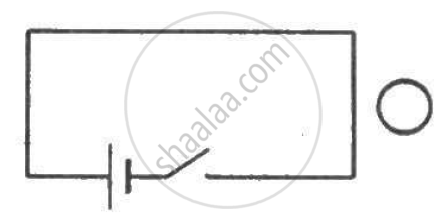
Consider the situation shown in figure. If the switch is closed and after some time it is opened again, the closed loop will show ____________ .
A bar magnet is moved along the axis of a copper ring placed far away from the magnet. Looking from the side of the magnet, an anticlockwise current is found to be induced in the ring. Which of the following may be true?
(a) The south pole faces the ring and the magnet moves towards it.
(b) The north pole faces the ring and the magnet moves towards it.
(c) The south pole faces the ring and the magnet moves away from it.
(d) The north pole faces the ring and the magnet moves away from it.
Explain, with the help of a suitable example, how we can show that Lenz's law is a consequence of the principle of conservation of energy.
Which of the following statements is not correct?
2 A 40 kg boy whose legs are 4 cm in area and 50 cm long falls through a height of 2 m without breaking his leg bones. If the bones can withstand stress of 0.9 x 10⁸ N/m2. The Young's modulus for the material of the bone is ______.
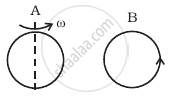
Same as problem 4 except the coil A is made to rotate about a vertical axis (figure). No current flows in B if A is at rest. The current in coil A, when the current in B (at t = 0) is counterclockwise and the coil A is as shown at this instant, t = 0, is ______.
A metallic ring of mass m and radius `l` (ring being horizontal) is falling under gravity in a region having a magnetic field. If z is the vertical direction, the z-component of magnetic field is Bz = Bo (1 + λz). If R is the resistance of the ring and if the ring falls with a velocity v, find the energy lost in the resistance. If the ring has reached a constant velocity, use the conservation of energy to determine v in terms of m, B, λ and acceleration due to gravity g.
Predict the direction of induced current in the situation described by the following figure.

Predict the direction of induced current in the situation described by the following figure.
What happens whenever the magnetic flux through a closed circuit changes?
What do Faraday's laws and Lenz's law form together?
Which apparatus is used to observe the induced current when a magnet moves relative to a coil?
What would happen to the magnet if an induced South pole attracted an approaching N-pole without external effort?
What happens as the rate of change of magnetic flux becomes greater?
A rectangular loop moves into a region where the magnetic field points out of the page. What happens to the flux through the loop?
