Advertisements
Advertisements
Question
Consider the situation shown in figure. If the closed loop is completely enclosed in the circuit containing the switch, the closed loop will show _______________ .
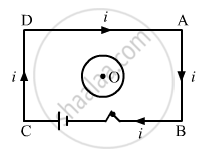
Options
an anticlockwise current-pulse
a clockwise current-pulse
an anticlockwise current-pulse and then a clockwise current-pulse
a clockwise current-pulse and then an anticlockwise current-pulse
Advertisements
Solution
an anticlockwise current-pulse and then a clockwise current-pulse
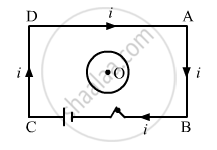
According to Lenz's law, the induced current in the loop will be such that it opposes the increase in the magnetic field due to current flow in the circuit. Therefore, the direction of the induced current when the switch is closed is anti-clockwise.
Similarly, when the switch is open, there is a sudden fall in the current, leading to decrease in the magnetic field at the centre of the loop. According to Lenz's law, the induced current in the loop is such that it opposes the decrease in the magnetic field. Therefore, the direction of the induced current when the switch is open is clockwise.
APPEARS IN
RELATED QUESTIONS
Describe a simple experiment (or activity) to show that the polarity of emf induced in a coil is always such that it tends to produce a current which opposes the change of magnetic flux that produces it.
Show that Lenz's law is a consequence of conservation of energy.
A bar magnet is released from rest along the axis of a very long, vertical copper tube. After some time the magnet ____________ .
Lenz’s law is a consequence of the law of conservation of ______.
Which of the following statements is not correct?
For a coil having L = 2 mH, current flows at the rate of 10-3 AIS. The e.m.f induced is
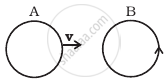
There are two coils A and B as shown in figure. A current starts flowing in B as shown, when A is moved towards B and stops when A stops moving. The current in A is counterclockwise. B is kept stationary when A moves. We can infer that ______.
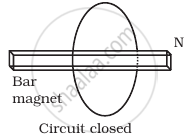
Consider a magnet surrounded by a wire with an on/off switch S (Figure). If the switch is thrown from the off position (open circuit) to the on position (closed circuit), will a current flow in the circuit? Explain.

A solenoid is connected to a battery so that a steady current flows through it. If an iron core is inserted into the solenoid, will the current increase or decrease? Explain.
A conducting wire XY of mass m and neglibile resistance slides smoothly on two parallel conducting wires as shown in figure. The closed circuit has a resistance R due to AC. AB and CD are perfect conductors. There is a ˆ. magnetic field `B = B(t)hatk`.
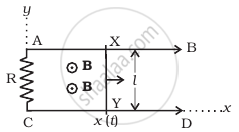
- Write down equation for the acceleration of the wire XY.
- If B is independent of time, obtain v(t) , assuming v(0) = u0.
- For (b), show that the decrease in kinetic energy of XY equals the heat lost in R.
Predict the direction of induced current in the situation described by the following figure.

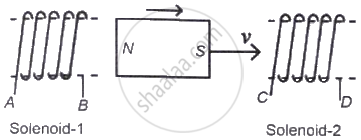
In the diagram given below, a strong bar magnet is moving towards solenoid-2 from solenoid-1. The direction of induced current in solenoid-1 and that in solenoid-2, respectively, are through the directions:
What do Faraday's laws and Lenz's law form together?
Which expression incorporates Lenz's law into Faraday's law?
When the N-pole moves away from the coil, what happens to the flux and galvanometer?
When the N-pole moves away from the coil, which induced current direction and near-face pole are observed?
What would happen to the magnet if an induced South pole attracted an approaching N-pole without external effort?
For a rectangular loop entering an out-of-page magnetic field, what is the induced current direction and path?
What is the induced current path for an irregular loop moving out of an out-of-page magnetic field?
