Advertisements
Advertisements
Question
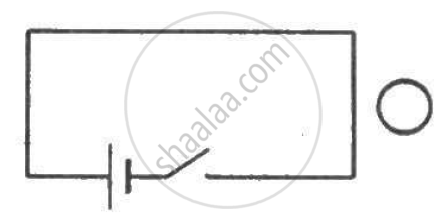
Consider the situation shown in figure. If the switch is closed and after some time it is opened again, the closed loop will show ____________ .
Options
an anticlockwise current-pulse
a clockwise current-pulse
an anticlockwise current-pulse and then a clockwise current-pulse
a clockwise current-pulse and then an anticlockwise current-pulse
Advertisements
Solution
a clockwise current-pulse and then an anticlockwise current-pulse
When the switch is closed, the current will flow in downward direction in part AB of the circuit nearest to the closed loop.
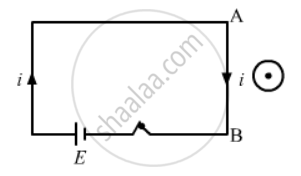
Due to current in wire AB, a magnetic field will be produced in the loop. This magnetic field due to increasing current will be the cause of the induced current in the closed loop. According to Lenz's law, the induced current is such that it opposes the increase in the magnetic field that induces it. So, the induced current will be in clockwise direction opposing the increase in the magnetic field in upward direction.
Similarly, when the circuit is opened, the current will suddenly fall in the circuit, leading to decrease in the magnetic field in the loop. Again, according to Lenz's law, the induced current is such that it opposes the decrease in the magnetic field. So, the induced current will be in anti-clockwise direction, opposing the decrease in the magnetic field in upward direction.
APPEARS IN
RELATED QUESTIONS
Predict the direction of induced current in the situation described by the following figure.

Use Lenz’s law to determine the direction of induced current in the situation described by the figure:
A wire of irregular shape turning into a circular shape.

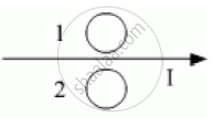
Predict the directions of induced currents in metal rings 1 and 2 lying in the same plane where current I in the wire is increasing steadily.
Predict the direction of induced current in a metal ring when the ring is moved towards a straight conductor with constant speed v. The conductor is carrying current I in the direction shown in the figure.
A pivoted aluminium bar falls much more slowly through a small region containing a magnetic field than a similar bar of an insulating material. Explain.
A bar magnet is moved along the axis of a copper ring placed far away from the magnet. Looking from the side of the magnet, an anticlockwise current is found to be induced in the ring. Which of the following may be true?
(a) The south pole faces the ring and the magnet moves towards it.
(b) The north pole faces the ring and the magnet moves towards it.
(c) The south pole faces the ring and the magnet moves away from it.
(d) The north pole faces the ring and the magnet moves away from it.
Energy dissipate in LCR circuit in
Lenz's law gives ______
A solenoid is connected to a battery so that a steady current flows through it. If an iron core is inserted into the solenoid, will the current increase or decrease? Explain.
A long solenoid ‘S’ has ‘n’ turns per meter, with diameter ‘a’. At the centre of this coil we place a smaller coil of ‘N’ turns and diameter ‘b’ (where b < a). If the current in the solenoid increases linearly, with time, what is the induced emf appearing in the smaller coil. Plot graph showing nature of variation in emf, if current varies as a function of mt2 + C.
Predict the direction of induced current in the situation described by the following figure.
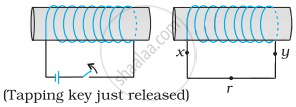
Use Lenz’s law to determine the direction of induced current in the situation described by the figure.
A circular loop being deformed into a narrow straight wire.

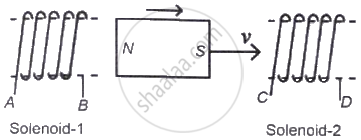
In the diagram given below, a strong bar magnet is moving towards solenoid-2 from solenoid-1. The direction of induced current in solenoid-1 and that in solenoid-2, respectively, are through the directions:
Who formulated Lenz's law in 1834?
Which expression incorporates Lenz's law into Faraday's law?
Which apparatus is used to observe the induced current when a magnet moves relative to a coil?
When the N-pole moves away from the coil, what happens to the flux and galvanometer?
What does the magnetic pole created on the near face of the coil oppose when a magnet moves?
How does an induced field oppose an increase in magnetic flux?
