Advertisements
Advertisements
Question
A solenoid is connected to a battery so that a steady current flows through it. If an iron core is inserted into the solenoid, will the current increase or decrease? Explain.
Advertisements
Solution
This problem is based on Lenz’s law and according to this law, the direction of induced emf or current in a circuit is such as to oppose the cause that produces it.

When the iron core is inserted in the current-carrying solenoid, the magnetic field increases due to the magnetisation of iron core and hence the flux increases.
So, the emf induced in the coil must oppose this increase in flux, so the current induced in the coil in such a direction that it will oppose the increasing magnetic field which can be done by making decrease in current. So, the current will decrease.
APPEARS IN
RELATED QUESTIONS
State Lenz's law. Illustrate, by giving an example, how this law helps in predicting the direction of the current in a loop in the presence of a changing magnetic flux.
Describe a simple experiment (or activity) to show that the polarity of emf induced in a coil is always such that it tends to produce a current which opposes the change of magnetic flux that produces it.
Use Lenz’s law to determine the direction of induced current in the situation described by the figure:
A wire of irregular shape turning into a circular shape.

Predict the directions of induced currents in metal rings 1 and 2 lying in the same plane where current I in the wire is increasing steadily.
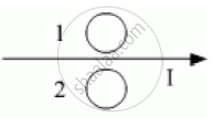
Predict the direction of induced current in metal rings 1 and 2 when current I in the wire is steadily decreasing?
Consider the situation shown in figure. If the switch is closed and after some time it is opened again, the closed loop will show ____________ .
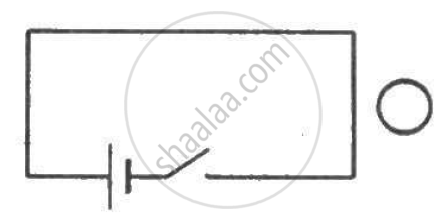
Two circular loops of equal radii are placed coaxially at some separation. The first is cut and a battery is inserted in between to drive a current in it. The current changes slightly because of the variation in resistance with temperature. During this period, the two loops _______________ .
A bar magnet is dropped through a copper ring acceleration of magnet is
For a coil having L = 2 mH, current flows at the rate of 10-3 AIS. The e.m.f induced is
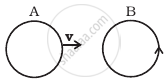
There are two coils A and B as shown in figure. A current starts flowing in B as shown, when A is moved towards B and stops when A stops moving. The current in A is counterclockwise. B is kept stationary when A moves. We can infer that ______.
Consider a metal ring kept on top of a fixed solenoid (say on a carboard) (Figure). The centre of the ring coincides with the axis of the solenoid. If the current is suddenly switched on, the metal ring jumps up. Explain

Which laws determine the magnitude of an induced EMF?
Who formulated Lenz's law in 1834?
Which apparatus is used to observe the induced current when a magnet moves relative to a coil?
How does an induced field oppose an increase in magnetic flux?
A rectangular loop moves into a region where the magnetic field points out of the page. What happens to the flux through the loop?
What is the induced current path for an irregular loop moving out of an out-of-page magnetic field?
