Advertisements
Advertisements
प्रश्न
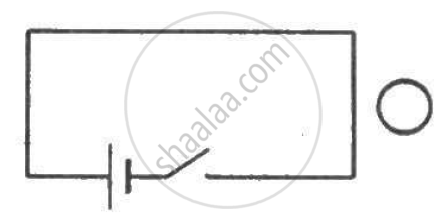
Consider the situation shown in figure. If the switch is closed and after some time it is opened again, the closed loop will show ____________ .
विकल्प
an anticlockwise current-pulse
a clockwise current-pulse
an anticlockwise current-pulse and then a clockwise current-pulse
a clockwise current-pulse and then an anticlockwise current-pulse
Advertisements
उत्तर
a clockwise current-pulse and then an anticlockwise current-pulse
When the switch is closed, the current will flow in downward direction in part AB of the circuit nearest to the closed loop.
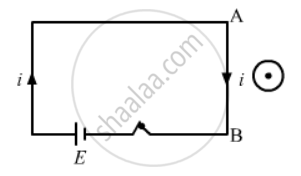
Due to current in wire AB, a magnetic field will be produced in the loop. This magnetic field due to increasing current will be the cause of the induced current in the closed loop. According to Lenz's law, the induced current is such that it opposes the increase in the magnetic field that induces it. So, the induced current will be in clockwise direction opposing the increase in the magnetic field in upward direction.
Similarly, when the circuit is opened, the current will suddenly fall in the circuit, leading to decrease in the magnetic field in the loop. Again, according to Lenz's law, the induced current is such that it opposes the decrease in the magnetic field. So, the induced current will be in anti-clockwise direction, opposing the decrease in the magnetic field in upward direction.
APPEARS IN
संबंधित प्रश्न
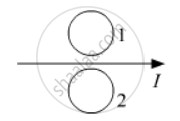
What is the direction of induced currents in metal rings 1 and 2 when current I in the wire is increasing steadily?
A bar magnet is moved in the direction indicated by the arrow between two coils PQ and CD. Predict the directions of induced current in each coil.

A short magnet is moved along the axis of a conducting loop. Show that the loop repels the magnet if the magnet is approaching the loop and attracts the magnet if it is going away from the loop.
The battery discussed in the previous question is suddenly disconnected. Is a current induced in the other loop? If yes, when does it start and when does it end? Do the loops attract each other or repel?
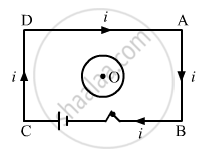
Consider the situation shown in figure. If the closed loop is completely enclosed in the circuit containing the switch, the closed loop will show _______________ .
Explain, with the help of a suitable example, how we can show that Lenz's law is a consequence of the principle of conservation of energy.
Young's modulus for aluminium is 7 × 10¹⁰ Pa. The force needed to stretch an aluminium wire of diameter 2 mm and length 800 mm by 1 mm is ______.
A bar magnet is dropped through a copper ring acceleration of magnet is
Energy dissipate in LCR circuit in
Lenz's law gives ______
A solenoid is connected to a battery so that a steady current flows through it. If an iron core is inserted into the solenoid, will the current increase or decrease? Explain.
A long solenoid ‘S’ has ‘n’ turns per meter, with diameter ‘a’. At the centre of this coil we place a smaller coil of ‘N’ turns and diameter ‘b’ (where b < a). If the current in the solenoid increases linearly, with time, what is the induced emf appearing in the smaller coil. Plot graph showing nature of variation in emf, if current varies as a function of mt2 + C.
A coil is suspended in a uniform magnetic field, with the plane of the coil parallel to the magnetic lines of force. When a current is passed through the coil it starts oscillating: It is very difficult to stop. But if an aluminium plate is placed near to the coil, it stops. This is due to:
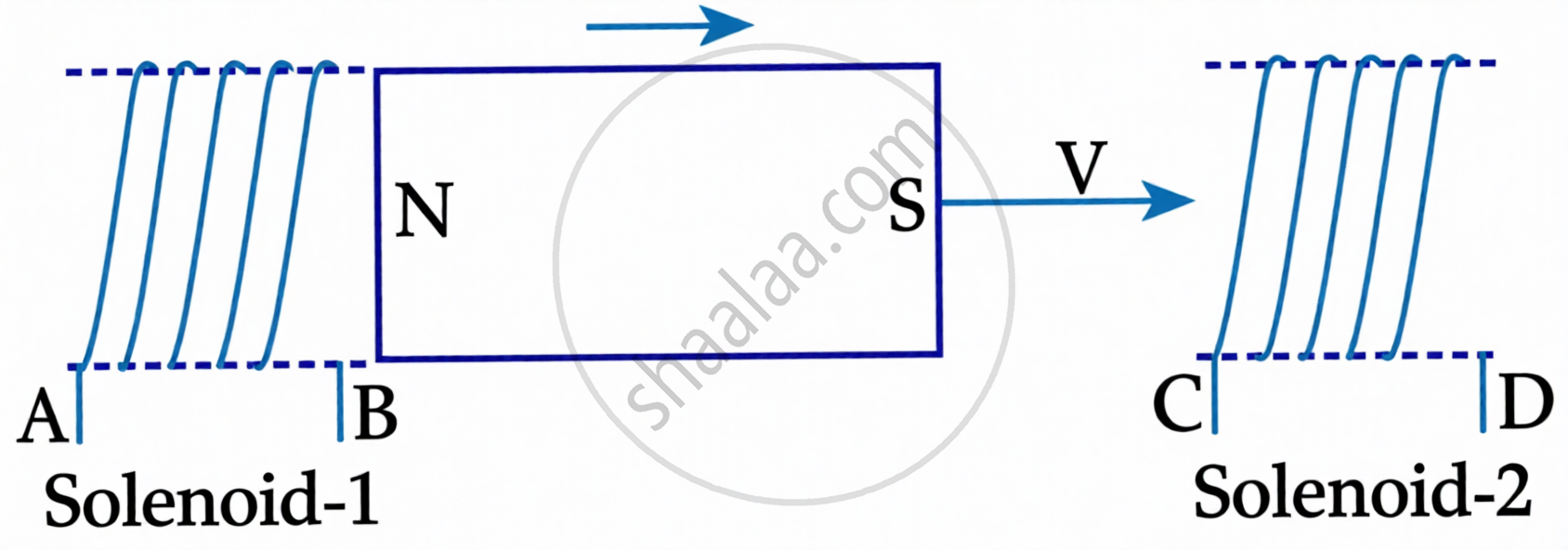
In the above diagram, a strong bar magnet is moving towards solenoid-2 from solenoid-1. The direction of induced current in solenoid-1 and that in solenoid-2, respectively, are through the directions:
What happens whenever the magnetic flux through a closed circuit changes?
Which laws determine the magnitude of an induced EMF?
Which apparatus is used to observe the induced current when a magnet moves relative to a coil?
Why must continuous mechanical work be supplied to an AC generator?
For a triangular loop leaving an out-of-page magnetic field, what is the induced current direction and path?
