Advertisements
Advertisements
प्रश्न
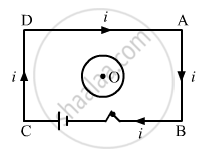
Consider the situation shown in figure. If the closed loop is completely enclosed in the circuit containing the switch, the closed loop will show _______________ .
विकल्प
an anticlockwise current-pulse
a clockwise current-pulse
an anticlockwise current-pulse and then a clockwise current-pulse
a clockwise current-pulse and then an anticlockwise current-pulse
Advertisements
उत्तर
an anticlockwise current-pulse and then a clockwise current-pulse
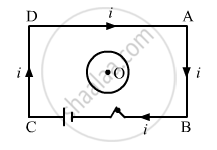
According to Lenz's law, the induced current in the loop will be such that it opposes the increase in the magnetic field due to current flow in the circuit. Therefore, the direction of the induced current when the switch is closed is anti-clockwise.
Similarly, when the switch is open, there is a sudden fall in the current, leading to decrease in the magnetic field at the centre of the loop. According to Lenz's law, the induced current in the loop is such that it opposes the decrease in the magnetic field. Therefore, the direction of the induced current when the switch is open is clockwise.
APPEARS IN
संबंधित प्रश्न
Predict the direction of induced current in the situation described by the following figure.

Predict the direction of induced current in metal rings 1 and 2 when current I in the wire is steadily decreasing?
A short magnet is moved along the axis of a conducting loop. Show that the loop repels the magnet if the magnet is approaching the loop and attracts the magnet if it is going away from the loop.
A bar magnet is released from rest along the axis of a very long, vertical copper tube. After some time the magnet ____________ .
Two circular loops of equal radii are placed coaxially at some separation. The first is cut and a battery is inserted in between to drive a current in it. The current changes slightly because of the variation in resistance with temperature. During this period, the two loops _______________ .
Young's modulus for aluminium is 7 × 10¹⁰ Pa. The force needed to stretch an aluminium wire of diameter 2 mm and length 800 mm by 1 mm is ______.
Energy dissipate in LCR circuit in
A wire in the form of a tightly wound solenoid is connected to a DC source, and carries a current. If the coil is stretched so that there are gaps between successive elements of the spiral coil, will the current increase or decrease? Explain.
A coil is suspended in a uniform magnetic field, with the plane of the coil parallel to the magnetic lines of force. When a current is passed through the coil it starts oscillating: It is very difficult to stop. But if an aluminium plate is placed near to the coil, it stops. This is due to:
Predict the direction of induced current in the situation described by the following figure.

Which laws determine the magnitude of an induced EMF?
What do Faraday's laws and Lenz's law form together?
When the N-pole moves away from the coil, which induced current direction and near-face pole are observed?
What does the magnetic pole created on the near face of the coil oppose when a magnet moves?
Suppose an induced current aided the flux change as an N-pole approached a coil. Which pole would form on the near face?
How does an induced field oppose a decrease in magnetic flux?
A rectangular loop moves into a region where the magnetic field points out of the page. What happens to the flux through the loop?
For a triangular loop leaving an out-of-page magnetic field, what is the induced current direction and path?
What is the induced current path for an irregular loop moving out of an out-of-page magnetic field?
