Advertisements
Advertisements
प्रश्न
A bar magnet is released from rest along the axis of a very long, vertical copper tube. After some time the magnet ____________ .
विकल्प
will stop in the tube
will move with almost contant speed
will move with an acceleration g
will oscillate
Advertisements
उत्तर
will move with almost contant speed
As the magnet is moving under gravity, the flux linked with the copper tube will change because of the motion of the magnet. This will produce eddy currents in the body of the copper tube. According to Lenz's law, these induced currents oppose the fall of the magnet. So, the magnet will experience a retarding force. This force will continuously increase with increasing velocity of the magnet till it becomes equal to the force of gravity. After this, the net force on the magnet will become zero. Hence, the magnet will attain a constant speed.
APPEARS IN
संबंधित प्रश्न
Use Lenz’s law to determine the direction of induced current in the situation described by the figure:
A wire of irregular shape turning into a circular shape.

A pivoted aluminium bar falls much more slowly through a small region containing a magnetic field than a similar bar of an insulating material. Explain.
A bar magnet is moved along the axis of a copper ring placed far away from the magnet. Looking from the side of the magnet, an anticlockwise current is found to be induced in the ring. Which of the following may be true?
(a) The south pole faces the ring and the magnet moves towards it.
(b) The north pole faces the ring and the magnet moves towards it.
(c) The south pole faces the ring and the magnet moves away from it.
(d) The north pole faces the ring and the magnet moves away from it.
Young's modulus for aluminium is 7 × 10¹⁰ Pa. The force needed to stretch an aluminium wire of diameter 2 mm and length 800 mm by 1 mm is ______.
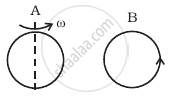
Same as problem 4 except the coil A is made to rotate about a vertical axis (figure). No current flows in B if A is at rest. The current in coil A, when the current in B (at t = 0) is counterclockwise and the coil A is as shown at this instant, t = 0, is ______.
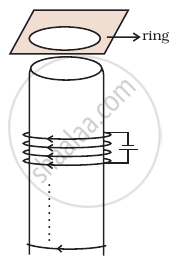
Consider a metal ring kept (supported by a cardboard) on top of a fixed solenoid carrying a current I (Figure). The centre of the ring coincides with the axis of the solenoid. If the current in the solenoid is switched off, what will happen to the ring?
A conducting wire XY of mass m and neglibile resistance slides smoothly on two parallel conducting wires as shown in figure. The closed circuit has a resistance R due to AC. AB and CD are perfect conductors. There is a ˆ. magnetic field `B = B(t)hatk`.
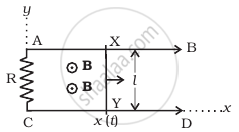
- Write down equation for the acceleration of the wire XY.
- If B is independent of time, obtain v(t) , assuming v(0) = u0.
- For (b), show that the decrease in kinetic energy of XY equals the heat lost in R.
Predict the direction of induced current in the situation described by the following figure.
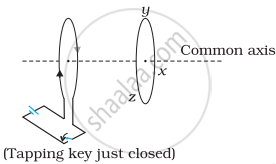
Predict the direction of induced current in the situation described by the following figure.

Who formulated Lenz's law in 1834?
How is Lenz's law related to the Law of Conservation of Energy?
What do Faraday's laws and Lenz's law form together?
Which expression incorporates Lenz's law into Faraday's law?
Suppose an induced current aided the flux change as an N-pole approached a coil. Which pole would form on the near face?
What would happen to the magnet if an induced South pole attracted an approaching N-pole without external effort?
How does an induced field oppose an increase in magnetic flux?
