Advertisements
Advertisements
प्रश्न
A pivoted aluminium bar falls much more slowly through a small region containing a magnetic field than a similar bar of an insulating material. Explain.
Advertisements
उत्तर
An aluminium bar falls slowly through a small region containing a magnetic field because of the induced eddy currents (or induced emf) in it. According to Lenz's law this induced eddy current oppose its cause (its motion). Hence, it slows down while falling through a region containing a magnetic field. On the other hand, non-metallic or insulating materials are free from such effects.
APPEARS IN
संबंधित प्रश्न
Describe a simple experiment (or activity) to show that the polarity of emf induced in a coil is always such that it tends to produce a current which opposes the change of magnetic flux that produces it.
The battery discussed in the previous question is suddenly disconnected. Is a current induced in the other loop? If yes, when does it start and when does it end? Do the loops attract each other or repel?
A bar magnet is released from rest along the axis of a very long, vertical copper tube. After some time the magnet ____________ .
Two circular loops of equal radii are placed coaxially at some separation. The first is cut and a battery is inserted in between to drive a current in it. The current changes slightly because of the variation in resistance with temperature. During this period, the two loops _______________ .
Which of the following statements is not correct?
For a coil having L = 2 mH, current flows at the rate of 10-3 AIS. The e.m.f induced is
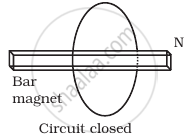
Consider a magnet surrounded by a wire with an on/off switch S (Figure). If the switch is thrown from the off position (open circuit) to the on position (closed circuit), will a current flow in the circuit? Explain.

A wire in the form of a tightly wound solenoid is connected to a DC source, and carries a current. If the coil is stretched so that there are gaps between successive elements of the spiral coil, will the current increase or decrease? Explain.
A conducting wire XY of mass m and neglibile resistance slides smoothly on two parallel conducting wires as shown in figure. The closed circuit has a resistance R due to AC. AB and CD are perfect conductors. There is a ˆ. magnetic field `B = B(t)hatk`.
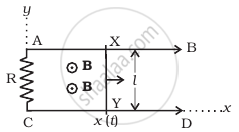
- Write down equation for the acceleration of the wire XY.
- If B is independent of time, obtain v(t) , assuming v(0) = u0.
- For (b), show that the decrease in kinetic energy of XY equals the heat lost in R.
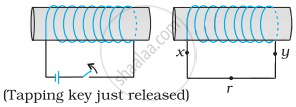
Predict the direction of induced current in the situation described by the following figure.
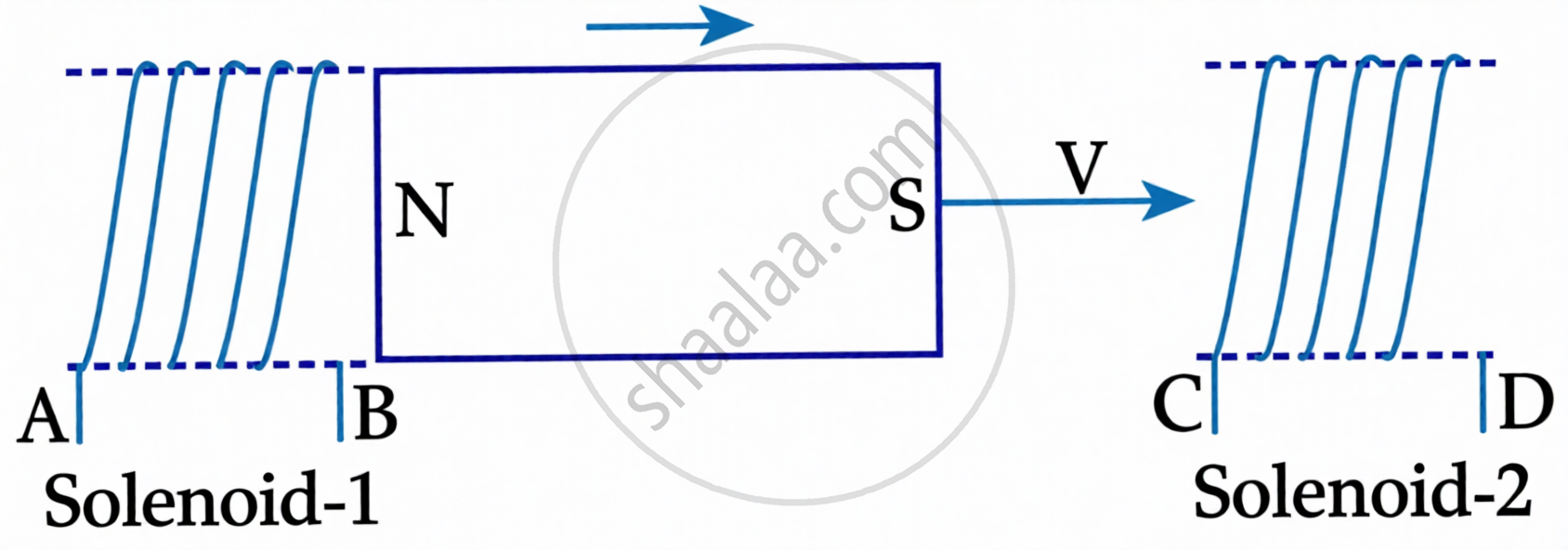
In the above diagram, a strong bar magnet is moving towards solenoid-2 from solenoid-1. The direction of induced current in solenoid-1 and that in solenoid-2, respectively, are through the directions:
What happens whenever the magnetic flux through a closed circuit changes?
Which laws determine the magnitude of an induced EMF?
What do Faraday's laws and Lenz's law form together?
Which expression incorporates Lenz's law into Faraday's law?
When the N-pole moves towards the coil, what happens to the flux and galvanometer?
What is observed when the magnet is held stationary near the coil?
How does an induced field oppose an increase in magnetic flux?
For a rectangular loop entering an out-of-page magnetic field, what is the induced current direction and path?
For a triangular loop leaving an out-of-page magnetic field, what is the induced current direction and path?
