Advertisements
Advertisements
प्रश्न
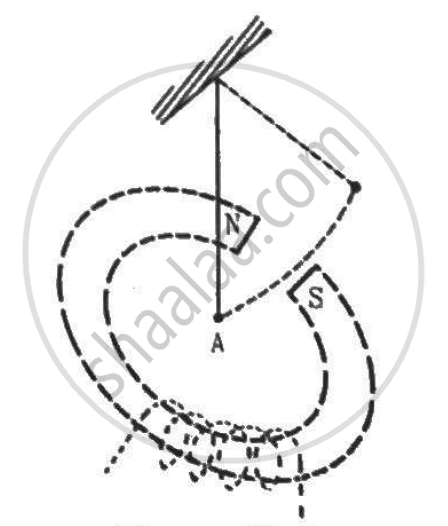
A metallic bob A oscillates through the space between the poles of an electromagnet (See the figure). The oscillations are more quickly damped when the circuit is on, as compared to the case when the circuit is off. Explain.
Advertisements
उत्तर
When the circuit is on, eddy currents are produced on the surface of the metallic bob. Due to these eddy currents, thermal energy is generated in it. This thermal energy comes at the cost of the kinetic energy of the bob; hence, oscillations are more quickly damped when the circuit is on compared to when the circuit is off.
APPEARS IN
संबंधित प्रश्न
State any two causes of energy loss in actual transformers.
Two spherical bobs, one metallic and the other of glass, of the same size are allowed to fall freely from the same height above the ground. Which of the two would reach earlier and why?
Give one example of use of eddy currents.
How are eddy currents produced ?
Describe briefly three main useful application of eddy currents ?
A metal sheet is placed in front of a strong magnetic pole. A force is needed to ______________ .
(a) hold the sheet there if the metal is magnetic
(b) hold the sheet there if the metal is nonmagnetic
(c) move the sheet away from the pole with uniform velocity if the metal is magnetic
(d) move the sheet away from the pole with uniform velocity if the metal is nonmagnetic.
Neglect any effect of paramagnetism, diamagnetism and gravity.
Write two examples of their useful applications .
In which of the following devices, the eddy current is not used ______
Why and where are eddy currents are undesirable? How are they minimized?
The plane in which eddy currents are produced in a conductor is inclined to the plane of the magnetic field at an angle equal to ______.
A constant retarding force of50 N is applied to a body of mass 20 kg moving initially with a speed of 15 ms-1. How long does the body take to stop?
Two simple pendula of length L and 4L are pulled aside to the right and are at rest so that they make an angle 30° with the vertical. They are then released simultaneously at time t = 0. The time after which they will be in phase is ______.
Eddy currents are also known as ______
Consider a metallic pipe with an inner radius of 1 cm. If a cylindrical bar magnet of radius 0.8 cm is dropped through the pipe, it takes more time to come down than it takes for a similar unmagnetised cylindrical iron bar dropped through the metallic pipe. Explain.
