Advertisements
Advertisements
Question
A bar magnet is released from rest along the axis of a very long, vertical copper tube. After some time the magnet ____________ .
Options
will stop in the tube
will move with almost contant speed
will move with an acceleration g
will oscillate
Advertisements
Solution
will move with almost contant speed
As the magnet is moving under gravity, the flux linked with the copper tube will change because of the motion of the magnet. This will produce eddy currents in the body of the copper tube. According to Lenz's law, these induced currents oppose the fall of the magnet. So, the magnet will experience a retarding force. This force will continuously increase with increasing velocity of the magnet till it becomes equal to the force of gravity. After this, the net force on the magnet will become zero. Hence, the magnet will attain a constant speed.
APPEARS IN
RELATED QUESTIONS
Predict the direction of induced current in metal rings 1 and 2 when current I in the wire is steadily decreasing?
Explain, with the help of a suitable example, how we can show that Lenz's law is a consequence of the principle of conservation of energy.
2 A 40 kg boy whose legs are 4 cm in area and 50 cm long falls through a height of 2 m without breaking his leg bones. If the bones can withstand stress of 0.9 x 10⁸ N/m2. The Young's modulus for the material of the bone is ______.
Energy dissipate in LCR circuit in
Lenz's law gives ______
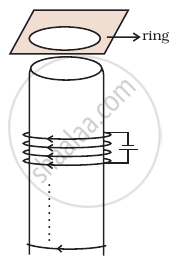
Consider a metal ring kept on top of a fixed solenoid (say on a carboard) (Figure). The centre of the ring coincides with the axis of the solenoid. If the current is suddenly switched on, the metal ring jumps up. Explain

Consider a metal ring kept (supported by a cardboard) on top of a fixed solenoid carrying a current I (Figure). The centre of the ring coincides with the axis of the solenoid. If the current in the solenoid is switched off, what will happen to the ring?
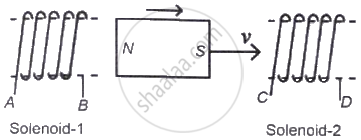
In the diagram given below, a strong bar magnet is moving towards solenoid-2 from solenoid-1. The direction of induced current in solenoid-1 and that in solenoid-2, respectively, are through the directions:
What happens whenever the magnetic flux through a closed circuit changes?
What do Faraday's laws and Lenz's law form together?
When the N-pole moves towards the coil, which induced current direction and near-face pole are observed?
When the N-pole moves away from the coil, which induced current direction and near-face pole are observed?
Suppose an induced current aided the flux change as an N-pole approached a coil. Which pole would form on the near face?
What would happen to the magnet if an induced South pole attracted an approaching N-pole without external effort?
How does an induced field oppose an increase in magnetic flux?
For a rectangular loop entering an out-of-page magnetic field, what is the induced current direction and path?
