Advertisements
Advertisements
Question
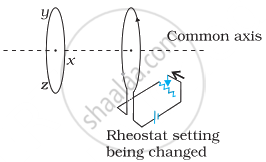
Predict the direction of induced current in the situation described by the following figure.
Advertisements
Solution

Lenz's law specifies the direction of the induced current in a closed loop. Using Lenz’s rule, the direction of the induced current in the given situation can be predicted as follows:
The current in the inner half of loop-1 will flow clockwise as the rheostat is turned down, weakening the North Pole.
The direction of the induced current is along zyxz.
RELATED QUESTIONS
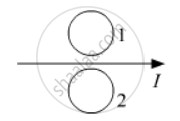
What is the direction of induced currents in metal rings 1 and 2 when current I in the wire is increasing steadily?
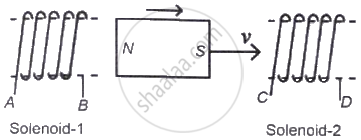
A bar magnet is moved in the direction indicated by the arrow between two coils PQ and CD. Predict the directions of induced current in each coil.

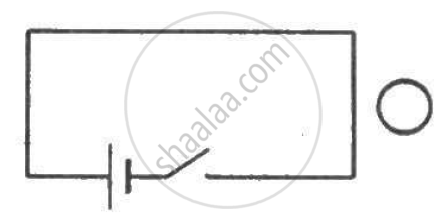
Consider the situation shown in figure. If the switch is closed and after some time it is opened again, the closed loop will show ____________ .
A bar magnet is moved along the axis of a copper ring placed far away from the magnet. Looking from the side of the magnet, an anticlockwise current is found to be induced in the ring. Which of the following may be true?
(a) The south pole faces the ring and the magnet moves towards it.
(b) The north pole faces the ring and the magnet moves towards it.
(c) The south pole faces the ring and the magnet moves away from it.
(d) The north pole faces the ring and the magnet moves away from it.
Which of the following statements is not correct?
2 A 40 kg boy whose legs are 4 cm in area and 50 cm long falls through a height of 2 m without breaking his leg bones. If the bones can withstand stress of 0.9 x 10⁸ N/m2. The Young's modulus for the material of the bone is ______.
For a coil having L = 2 mH, current flows at the rate of 10-3 AIS. The e.m.f induced is
A wire in the form of a tightly wound solenoid is connected to a DC source, and carries a current. If the coil is stretched so that there are gaps between successive elements of the spiral coil, will the current increase or decrease? Explain.
A long solenoid ‘S’ has ‘n’ turns per meter, with diameter ‘a’. At the centre of this coil we place a smaller coil of ‘N’ turns and diameter ‘b’ (where b < a). If the current in the solenoid increases linearly, with time, what is the induced emf appearing in the smaller coil. Plot graph showing nature of variation in emf, if current varies as a function of mt2 + C.
A coil is suspended in a uniform magnetic field, with the plane of the coil parallel to the magnetic lines of force. When a current is passed through the coil it starts oscillating: It is very difficult to stop. But if an aluminium plate is placed near to the coil, it stops. This is due to:
Use Lenz’s law to determine the direction of induced current in the situation described by the figure.
A circular loop being deformed into a narrow straight wire.

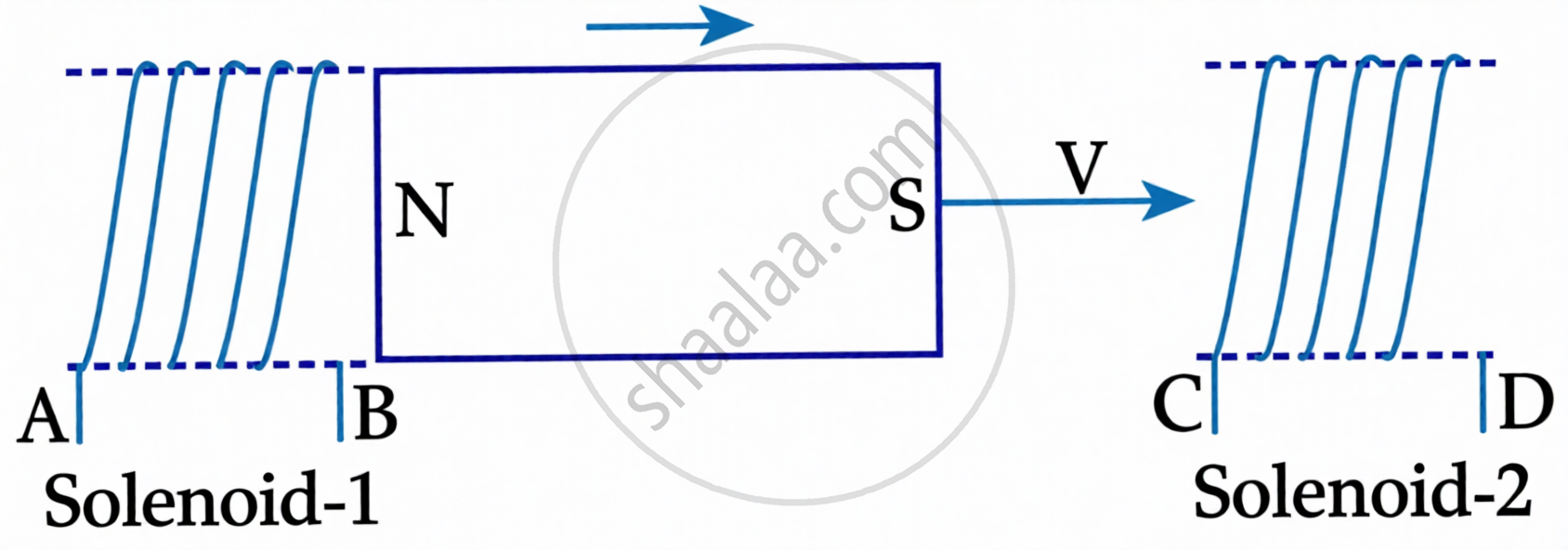
In the above diagram, a strong bar magnet is moving towards solenoid-2 from solenoid-1. The direction of induced current in solenoid-1 and that in solenoid-2, respectively, are through the directions:
In the diagram given below, a strong bar magnet is moving towards solenoid-2 from solenoid-1. The direction of induced current in solenoid-1 and that in solenoid-2, respectively, are through the directions:
What is observed when the magnet is held stationary near the coil?
How does an induced field oppose an increase in magnetic flux?
In what sense does Lenz's law behave like electromagnetic inertia?
Why must continuous mechanical work be supplied to an AC generator?
What is the induced current path for an irregular loop moving out of an out-of-page magnetic field?
