Advertisements
Advertisements
Question
A short magnet is moved along the axis of a conducting loop. Show that the loop repels the magnet if the magnet is approaching the loop and attracts the magnet if it is going away from the loop.
Advertisements
Solution

Consider the above situation in which a magnet is moved towards a conducting circular loop. The north pole of the magnet faces the loop. As the magnet comes closer to the loop, the magnetic field increases; hence, flux through the loop increases. According to Lenz's law, the direction of induced current is such that it opposes the magnetic field that has induced it. Thus, the induced current produces a magnetic field in the direction opposite to the original field; hence, the loop repels the magnet.
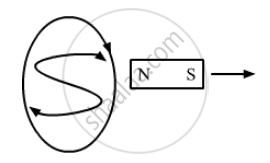
On the other hand, when the magnet is going away from the loop, the magnetic field decreases. Hence, flux through the loop decreases. According to Lenz's law, the induced current produces a magnetic field in the opposite direction of the original field; hence, the loop attracts the magnet.
APPEARS IN
RELATED QUESTIONS
Predict the direction of induced current in the situation described by the following figure.

Predict the direction of induced current in a metal ring when the ring is moved towards a straight conductor with constant speed v. The conductor is carrying current I in the direction shown in the figure.
Which of the following statements is not correct?
2 A 40 kg boy whose legs are 4 cm in area and 50 cm long falls through a height of 2 m without breaking his leg bones. If the bones can withstand stress of 0.9 x 10⁸ N/m2. The Young's modulus for the material of the bone is ______.
Energy dissipate in LCR circuit in
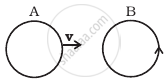
There are two coils A and B as shown in figure. A current starts flowing in B as shown, when A is moved towards B and stops when A stops moving. The current in A is counterclockwise. B is kept stationary when A moves. We can infer that ______.
A solenoid is connected to a battery so that a steady current flows through it. If an iron core is inserted into the solenoid, will the current increase or decrease? Explain.
Consider a metal ring kept on top of a fixed solenoid (say on a carboard) (Figure). The centre of the ring coincides with the axis of the solenoid. If the current is suddenly switched on, the metal ring jumps up. Explain

A conducting wire XY of mass m and neglibile resistance slides smoothly on two parallel conducting wires as shown in figure. The closed circuit has a resistance R due to AC. AB and CD are perfect conductors. There is a ˆ. magnetic field `B = B(t)hatk`.
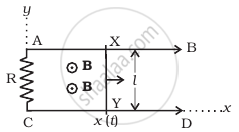
- Write down equation for the acceleration of the wire XY.
- If B is independent of time, obtain v(t) , assuming v(0) = u0.
- For (b), show that the decrease in kinetic energy of XY equals the heat lost in R.
Predict the direction of induced current in the situation described by the following figure.

Predict the direction of induced current in the situation described by the following figure.
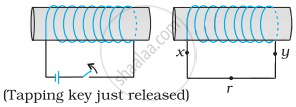
What happens whenever the magnetic flux through a closed circuit changes?
How is Lenz's law related to the Law of Conservation of Energy?
What do Faraday's laws and Lenz's law form together?
Which expression incorporates Lenz's law into Faraday's law?
When the N-pole moves towards the coil, which induced current direction and near-face pole are observed?
Suppose an induced current aided the flux change as an N-pole approached a coil. Which pole would form on the near face?
For a triangular loop leaving an out-of-page magnetic field, what is the induced current direction and path?
