Advertisements
Advertisements
Question
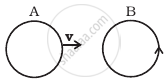
The battery discussed in the previous question is suddenly disconnected. Is a current induced in the other loop? If yes, when does it start and when does it end? Do the loops attract each other or repel?
Advertisements
Solution
When the battery is suddenly disconnected, a current is induced in loop B due to a sudden change in the flux through it. It is only induced for a moment when the current suddenly falls to zero. There is no induced current after it has fallen to zero. According to Lenz's law, the induced current is such that it increases the decreasing magnetic field. So, if the current in loop A is in clockwise direction, the induced current in loop B will also be in clockwise direction. Hence, the two loops will attract each other.
APPEARS IN
RELATED QUESTIONS
State Lenz's law. Illustrate, by giving an example, how this law helps in predicting the direction of the current in a loop in the presence of a changing magnetic flux.
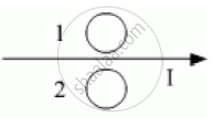
Predict the directions of induced currents in metal rings 1 and 2 lying in the same plane where current I in the wire is increasing steadily.
A bar magnet is released from rest along the axis of a very long, vertical copper tube. After some time the magnet ____________ .
Lenz's law gives ______
There are two coils A and B as shown in figure. A current starts flowing in B as shown, when A is moved towards B and stops when A stops moving. The current in A is counterclockwise. B is kept stationary when A moves. We can infer that ______.
A solenoid is connected to a battery so that a steady current flows through it. If an iron core is inserted into the solenoid, will the current increase or decrease? Explain.
A conducting wire XY of mass m and neglibile resistance slides smoothly on two parallel conducting wires as shown in figure. The closed circuit has a resistance R due to AC. AB and CD are perfect conductors. There is a ˆ. magnetic field `B = B(t)hatk`.
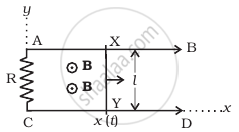
- Write down equation for the acceleration of the wire XY.
- If B is independent of time, obtain v(t) , assuming v(0) = u0.
- For (b), show that the decrease in kinetic energy of XY equals the heat lost in R.
A metallic ring of mass m and radius `l` (ring being horizontal) is falling under gravity in a region having a magnetic field. If z is the vertical direction, the z-component of magnetic field is Bz = Bo (1 + λz). If R is the resistance of the ring and if the ring falls with a velocity v, find the energy lost in the resistance. If the ring has reached a constant velocity, use the conservation of energy to determine v in terms of m, B, λ and acceleration due to gravity g.
Predict the direction of induced current in the situation described by the following figure.

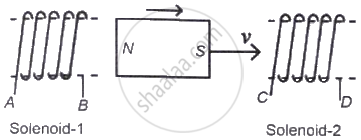
In the diagram given below, a strong bar magnet is moving towards solenoid-2 from solenoid-1. The direction of induced current in solenoid-1 and that in solenoid-2, respectively, are through the directions:
Who formulated Lenz's law in 1834?
How is Lenz's law related to the Law of Conservation of Energy?
When the N-pole moves towards the coil, which induced current direction and near-face pole are observed?
Suppose an induced current aided the flux change as an N-pole approached a coil. Which pole would form on the near face?
For a triangular loop leaving an out-of-page magnetic field, what is the induced current direction and path?
What is the induced current path for an irregular loop moving out of an out-of-page magnetic field?
