Advertisements
Advertisements
Question
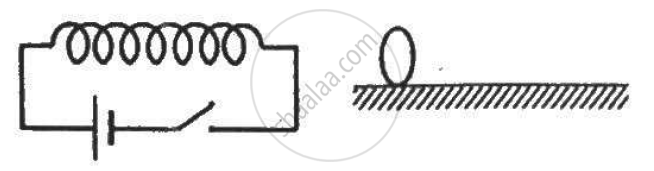
Figure shows a horizontal solenoid connected to a battery and a switch. A copper ring is placed on a frictionless track, the axis of the ring being along the axis of the solenoid. As the switch is closed, the ring will __________ .
Options
remain stationary
move towards the solenoid
move away from the solenoid
move towards the solenoid or away from it depending on which terminal (positive or negative) of the battery is connected to the left end of the solenoid
Advertisements
Solution
move away from the solenoid

For the circuit,
`E=-L(di)/(dt)`
The current will increase in the solenoid, flowing in clockwise direction in the circuit. Due to this increased current, the flux linked with the copper ring with increase with time, causing an induced current. This induced current will oppose the cause producing it. Hence, the current in the copper ring will be in anticlockwise direction. Now, because the directions of currents in the solenoid and ring are opposite, the ring will be repelled and hence will move away from the solenoid.
APPEARS IN
RELATED QUESTIONS
Ram is a student of class X in a village school. His uncle gifted him a bicycle with a dynamo fitted in it. He was very excited to get it. While cycling during night, he could light the bulb and see the objects on the road. He, however, did not know how this device works. he asked this question to his teacher. The teacher considered it an opportunity to explain the working to the whole class.
Answer the following questions:
(a) State the principle and working of a dynamo.
(b) Write two values each displayed by Ram and his school teacher.
The current flowing through an inductor of self inductance L is continuously increasing. Plot a graph showing the variation of
Magnetic flux versus the current
How does the mutual inductance of a pair of coils change when
(i) distance between the coils is increased and
(ii) number of turns in the coils is increased?
An inductor is connected to a battery through a switch. Explain why the emf induced in the inductor is much larger when the switch is opened as compared to the emf induced when the switch is closed.
Answer the following question.
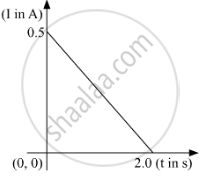
When a conducting loop of resistance 10 Ω and area 10 cm2 is removed from an external magnetic field acting normally, the variation of induced current-I in the loop with time t is as shown in the figure.
Find the
(a) total charge passed through the loop.
(b) change in magnetic flux through the loop
(c) magnitude of the field applied
Whenever the magnetic flux linked with an electric circuit changes, an emf is induced in the circuit. This is called ______.
The magnetic flux linked with a coil of N turns of area of cross-section A held with its plane parallel to the field B is ______.
Two inductors of inductance L each are connected in series with the opposite? magnetic fluxes. The resultant inductance is ______.
The magnetic flux linked with the coil (in Weber) is given by the equation- Փ = 5t2 + 3t + 16. The induced EMF in the coil at time, t = 4 will be ______.
The dimensions of magnetic flux are ______
A circular coil has radius ‘r', number of turns ‘N’ and carries a current ‘I’. Magnetic flux density ‘B’ at its centre is ______.
Which symbol represents magnetic flux?
What does \[\vec B\] represent in the magnetic flux formula?
What does \[A\] represent in \[\Phi_B=BA\cos\theta\]?
Which equivalent unit of magnetic flux uses volt and second?
What is the dimensional formula of magnetic flux?
What is the flux when the magnetic field is at an angle \[\theta\] to the area vector?
What happens to magnetic flux when area \[A\] increases while magnetic field and orientation remain unchanged?
Which factor describes how orientation affects magnetic flux?
