Advertisements
Advertisements
Question
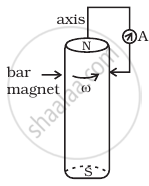
A cylindrical bar magnet is rotated about its axis (Figure). A wire is connected from the axis and is made to touch the cylindrical surface through a contact. Then
Options
a direct current flows in the ammeter A.
no current flows through the ammeter A.
an alternating sinusoidal current flows through the ammeter A with a time period T = 2π/ω.
a time varying non-sinosoidal current flows through the ammeter A.
Advertisements
Solution
A cylindrical bar magnet is rotated about its axis (Figure). A wire is connected from the axis and is made to touch the cylindrical surface through a contact. Then no current flows through the ammeter A.
Explanation:
The phenomenon of electromagnetic induction is used in this problem. Whenever the number of magnetic lines of force (magnetic flux) passing through a circuit changes (or a moving conductor cuts the magnetic flux) an emf is produced in the circuit (or emf induces across the ends of the conductor) is called induced emf. The induced emf persists only as long as there is a change or cutting of flux.
When cylindrical bar magnet is rotated about its axis, no change in flux linked with the circuit takes place, consequently no emf is induced and hence, no current flows through the ammeter A. Hence the ammeter shows no deflection.

APPEARS IN
RELATED QUESTIONS
A square loop MNOP of side 20 cm is placed horizontally in a uniform magnetic field acting vertically downwards as shown in the figure. The loop is pulled with a constant velocity of 20 cm s−1 till it goes out of the field.
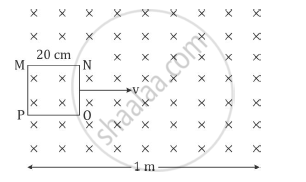
(i) Depict the direction of the induced current in the loop as it goes out of the field. For how long would the current in the loop persist?
(ii) Plot a graph showing the variation of magnetic flux and induced emf as a function of time.
A metallic loop is placed in a nonuniform magnetic field. Will an emf be induced in the loop?
Two inductors of inductance L each are connected in series with the opposite? magnetic fluxes. The resultant inductance is ______.
The magnetic flux linked with a coil in Wb is given by the equation Φ = 3t2 + 4t + 9. Then the magnitude of induced emf at t = 2 sec will be ______.
The dimensions of magnetic flux are ______
The unit of magnetic flux in SI is ______
A circular coil has radius ‘r', number of turns ‘N’ and carries a current ‘I’. Magnetic flux density ‘B’ at its centre is ______.
What does \[A\] represent in \[\Phi_B=BA\cos\theta\]?
What is the nature of magnetic flux?
What is the dimensional formula of magnetic flux?
What is the flux when the magnetic field is at an angle \[\theta\] to the area vector?
What happens to magnetic flux when magnetic field \[B\] increases while area and orientation remain unchanged?
What happens to magnetic flux when area \[A\] increases while magnetic field and orientation remain unchanged?
Which factor describes how orientation affects magnetic flux?
Which expression relates induced emf to the change in magnetic flux for a coil of \[N\] turns?
Which expression is Gauss's Law for Magnetism?
