Advertisements
Advertisements
Question
Answer the following question.
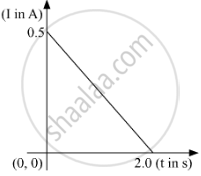
When a conducting loop of resistance 10 Ω and area 10 cm2 is removed from an external magnetic field acting normally, the variation of induced current-I in the loop with time t is as shown in the figure.
Find the
(a) total charge passed through the loop.
(b) change in magnetic flux through the loop
(c) magnitude of the field applied
Advertisements
Solution
`I = ("dq")/("dt") ⇒ "dq = "I"d"t"`
Hence area under the I-t curve gives charge flown.
Area of the I-t curve (as given in the question) = `1/2 xx 2 xx 1/2 = 0.5`
Total charge passed through the loop = 0.5 C
Now we know
`Δ"Q" = (Δvarphi)/"R"`
`Δvarphi = Δ"Q" xx "R" = 1/2 xx 10Omega = 5 "Wb"`
Charge in magnetic flux through the loop= 5 Wb
`Δvarphi = "B" (Δ"A")`
`5 = "B" (0.001)`
`"B" = 5000 "T"`
The magnitude of the field applied = 5000 T
APPEARS IN
RELATED QUESTIONS
The current flowing through an inductor of self inductance L is continuously increasing. Plot a graph showing the variation of
Magnetic flux versus the current
A pair of adjacent coils has a mutual inductance of 1.5 H. If the current in one coil changes from 0 to 20 A in 0.5 s, what is the change of flux linkage with the other coil?
How does the mutual inductance of a pair of coils change when
(i) distance between the coils is increased and
(ii) number of turns in the coils is increased?
Whenever the magnetic flux linked with an electric circuit changes, an emf is induced in the circuit. This is called ______.
A square of side L meters lies in the x-y plane in a region, where the magnetic field is given by `B = Bo(2hati + 3hatj + 4hatk)`T, where B0 is constant. The magnitude of flux passing through the square is ______.
What does \[\vec B\] represent in the magnetic flux formula?
What is \[\theta\] in \[\Phi_B=BA\cos\theta\]?
Which equivalent unit of magnetic flux uses tesla and square metres?
What is the flux when the magnetic field is at an angle \[\theta\] to the area vector?
When is magnetic flux maximum relative to the plane of the surface?
