Advertisements
Advertisements
Question
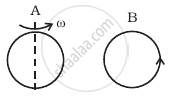
Same as problem 4 except the coil A is made to rotate about a vertical axis (figure). No current flows in B if A is at rest. The current in coil A, when the current in B (at t = 0) is counterclockwise and the coil A is as shown at this instant, t = 0, is ______.
Options
constant current clockwise.
varying current clockwise.
varying current counterclockwise.
constant current counterclockwise.
Advertisements
Solution
Same as problem 4 except the coil A is made to rotate about a vertical axis (figure). No current flows in B if A is at rest. The current in coil A, when the current in B (at t = 0) is counterclockwise and the coil A is as shown at this instant, t = 0, is constant current clockwise.
Explanation:
In this problem, Lenz’s law is applicable so let us introduce Lenz’s law first.
Lenz’s law gives the direction of induced emf/induced current. According to this law, the direction of induced emf or current in a circuit is such as to oppose the cause that produces it. This law is based upon law of conservation of energy.
When the current in coil B (at t = 0) is counter-clockwise and coil A is considered above it. The counterclockwise flow of the current in coil B is equivalent to north pole of magnet and magnetic field lines are eliminated upward to coil A. When coil A starts rotating at t = 0, the current in A is constant along a clockwise direction by Lenz’s rule.
APPEARS IN
RELATED QUESTIONS
Show that Lenz's law is a consequence of conservation of energy.
Predict the directions of induced currents in metal rings 1 and 2 lying in the same plane where current I in the wire is increasing steadily.
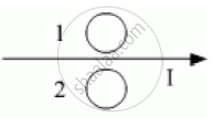
Predict the direction of induced current in metal rings 1 and 2 when current I in the wire is steadily decreasing?
Lenz’s law is a consequence of the law of conservation of ______.
Lenz's law gives ______
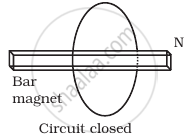
Consider a magnet surrounded by a wire with an on/off switch S (Figure). If the switch is thrown from the off position (open circuit) to the on position (closed circuit), will a current flow in the circuit? Explain.

A wire in the form of a tightly wound solenoid is connected to a DC source, and carries a current. If the coil is stretched so that there are gaps between successive elements of the spiral coil, will the current increase or decrease? Explain.
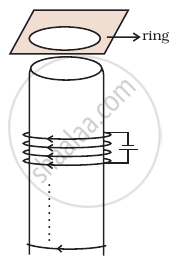
Consider a metal ring kept (supported by a cardboard) on top of a fixed solenoid carrying a current I (Figure). The centre of the ring coincides with the axis of the solenoid. If the current in the solenoid is switched off, what will happen to the ring?
Use Lenz’s law to determine the direction of induced current in the situation described by the figure.
A circular loop being deformed into a narrow straight wire.

What do Faraday's laws and Lenz's law form together?
Which expression incorporates Lenz's law into Faraday's law?
Which apparatus is used to observe the induced current when a magnet moves relative to a coil?
When the N-pole moves towards the coil, which induced current direction and near-face pole are observed?
When the N-pole moves away from the coil, which induced current direction and near-face pole are observed?
How does an induced field oppose an increase in magnetic flux?
In what sense does Lenz's law behave like electromagnetic inertia?
A rectangular loop moves into a region where the magnetic field points out of the page. What happens to the flux through the loop?
For a rectangular loop entering an out-of-page magnetic field, what is the induced current direction and path?
