Advertisements
Advertisements
प्रश्न
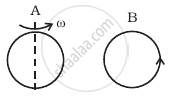
Same as problem 4 except the coil A is made to rotate about a vertical axis (figure). No current flows in B if A is at rest. The current in coil A, when the current in B (at t = 0) is counterclockwise and the coil A is as shown at this instant, t = 0, is ______.
पर्याय
constant current clockwise.
varying current clockwise.
varying current counterclockwise.
constant current counterclockwise.
Advertisements
उत्तर
Same as problem 4 except the coil A is made to rotate about a vertical axis (figure). No current flows in B if A is at rest. The current in coil A, when the current in B (at t = 0) is counterclockwise and the coil A is as shown at this instant, t = 0, is constant current clockwise.
Explanation:
In this problem, Lenz’s law is applicable so let us introduce Lenz’s law first.
Lenz’s law gives the direction of induced emf/induced current. According to this law, the direction of induced emf or current in a circuit is such as to oppose the cause that produces it. This law is based upon law of conservation of energy.
When the current in coil B (at t = 0) is counter-clockwise and coil A is considered above it. The counterclockwise flow of the current in coil B is equivalent to north pole of magnet and magnetic field lines are eliminated upward to coil A. When coil A starts rotating at t = 0, the current in A is constant along a clockwise direction by Lenz’s rule.
APPEARS IN
संबंधित प्रश्न
Predict the direction of induced current in metal rings 1 and 2 when current I in the wire is steadily decreasing?
Lenz’s law is a consequence of the law of conservation of ______.
2 A 40 kg boy whose legs are 4 cm in area and 50 cm long falls through a height of 2 m without breaking his leg bones. If the bones can withstand stress of 0.9 x 10⁸ N/m2. The Young's modulus for the material of the bone is ______.
Young's modulus for aluminium is 7 × 10¹⁰ Pa. The force needed to stretch an aluminium wire of diameter 2 mm and length 800 mm by 1 mm is ______.
A bar magnet is dropped through a copper ring acceleration of magnet is
Energy dissipate in LCR circuit in
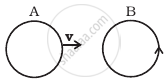
There are two coils A and B as shown in figure. A current starts flowing in B as shown, when A is moved towards B and stops when A stops moving. The current in A is counterclockwise. B is kept stationary when A moves. We can infer that ______.
A conducting wire XY of mass m and neglibile resistance slides smoothly on two parallel conducting wires as shown in figure. The closed circuit has a resistance R due to AC. AB and CD are perfect conductors. There is a ˆ. magnetic field `B = B(t)hatk`.
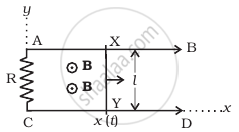
- Write down equation for the acceleration of the wire XY.
- If B is independent of time, obtain v(t) , assuming v(0) = u0.
- For (b), show that the decrease in kinetic energy of XY equals the heat lost in R.
Predict the direction of induced current in the situation described by the following figure.

Predict the direction of induced current in the situation described by the following figure.
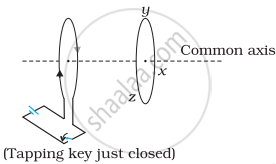
What happens whenever the magnetic flux through a closed circuit changes?
When the N-pole moves towards the coil, what happens to the flux and galvanometer?
Suppose an induced current aided the flux change as an N-pole approached a coil. Which pole would form on the near face?
What would happen to the magnet if an induced South pole attracted an approaching N-pole without external effort?
How does an induced field oppose an increase in magnetic flux?
What happens as the rate of change of magnetic flux becomes greater?
Why must continuous mechanical work be supplied to an AC generator?
