Advertisements
Advertisements
प्रश्न
A long solenoid ‘S’ has ‘n’ turns per meter, with diameter ‘a’. At the centre of this coil we place a smaller coil of ‘N’ turns and diameter ‘b’ (where b < a). If the current in the solenoid increases linearly, with time, what is the induced emf appearing in the smaller coil. Plot graph showing nature of variation in emf, if current varies as a function of mt2 + C.
Advertisements
उत्तर
Magnetic field due to a solenoid is given by, B = μ0ni where signs are as usual.
In this problem, the current is varying with time. Due to this an emf is induced in the coil of radius b.
`B_1(t) = mu_0nI(t)`
This varying magnetic field changes flux in the smaller coil.
Magnetic flux in IInd coil
`phi_2 = B(t).A`
= `mu_0nI(t).pib^2`
Induced e.m.f in second coil due to solenoid's varying magnetic field in 1 turn
`ε^' = (-dphi_2)/(dt) = (-d)/(dt) mu_0npib^2I(t)`
= `- mu_0npib^2 d/(dt) (mt^2 + C)`
= `- mu_0npib^2. 2mt`
So net e.m.f. produced in N turns of smaller coil
| ε = `- mu_0Nn pi b^2 2mt` |
APPEARS IN
संबंधित प्रश्न
Describe a simple experiment (or activity) to show that the polarity of emf induced in a coil is always such that it tends to produce a current which opposes the change of magnetic flux that produces it.
Use Lenz’s law to determine the direction of induced current in the situation described by the figure:
A wire of irregular shape turning into a circular shape.

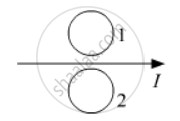
What is the direction of induced currents in metal rings 1 and 2 when current I in the wire is increasing steadily?
Two circular loops of equal radii are placed coaxially at some separation. The first is cut and a battery is inserted in between to drive a current in it. The current changes slightly because of the variation in resistance with temperature. During this period, the two loops _______________ .
Explain, with the help of a suitable example, how we can show that Lenz's law is a consequence of the principle of conservation of energy.
Lenz’s law is a consequence of the law of conservation of ______.
A bar magnet is dropped through a copper ring acceleration of magnet is
Energy dissipate in LCR circuit in
Lenz's law gives ______
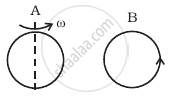
Same as problem 4 except the coil A is made to rotate about a vertical axis (figure). No current flows in B if A is at rest. The current in coil A, when the current in B (at t = 0) is counterclockwise and the coil A is as shown at this instant, t = 0, is ______.
Consider a metal ring kept on top of a fixed solenoid (say on a carboard) (Figure). The centre of the ring coincides with the axis of the solenoid. If the current is suddenly switched on, the metal ring jumps up. Explain

Predict the direction of induced current in the situation described by the following figure.

Which laws determine the magnitude of an induced EMF?
Which expression incorporates Lenz's law into Faraday's law?
Suppose an induced current aided the flux change as an N-pole approached a coil. Which pole would form on the near face?
What would happen to the magnet if an induced South pole attracted an approaching N-pole without external effort?
