Advertisements
Advertisements
प्रश्न
Show that Lenz's law is a consequence of conservation of energy.
Advertisements
उत्तर
According to Lenz law, the polarity of the induced emf is such that it opposes the change in magnetic flux responsible for its production.
Experiment:
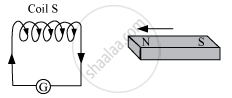
When the bar magnet with its N-pole is moved towards the coil, the induced current produced in coil S opposes the motion of magnet. It will happen so, if the induced current in the coil S produces magnetic field lines from left to right i.e., if the induced current flows through the coil S in clockwise direction (when seen from left).
Lenz Law and Principle of Conservation of Energy
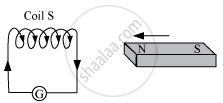
Lenz law is in accordance with the law of conservation of energy. In the above experiment, when N-pole of magnet is moved towards the coil, the right face of the coil acquires North polarity. Thus, work has to be done against the force of repulsion in bringing the magnet closer to the coil.
When N pole of magnet is moved away, South pole develops on the right face of the coil. Therefore, work has to be done against the force of attraction in taking the magnet away from the coil.
This mechanical work in moving the magnet with respect to the coil changes into electrical energy producing induced current. Hence, energy transformation takes place. Hence, we can say that Lenz's law is a consequence of conservation of energy.
APPEARS IN
संबंधित प्रश्न
Predict the direction of induced current in metal rings 1 and 2 when current I in the wire is steadily decreasing?
Consider the situation shown in figure. If the closed loop is completely enclosed in the circuit containing the switch, the closed loop will show _______________ .
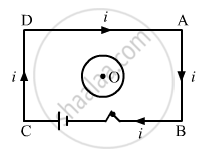
Consider a magnet surrounded by a wire with an on/off switch S (Figure). If the switch is thrown from the off position (open circuit) to the on position (closed circuit), will a current flow in the circuit? Explain.

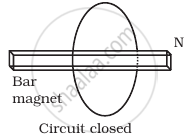
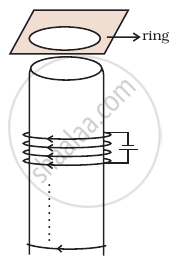
Consider a metal ring kept (supported by a cardboard) on top of a fixed solenoid carrying a current I (Figure). The centre of the ring coincides with the axis of the solenoid. If the current in the solenoid is switched off, what will happen to the ring?
How is Lenz's law related to the Law of Conservation of Energy?
When the N-pole moves towards the coil, what happens to the flux and galvanometer?
What is observed when the magnet is held stationary near the coil?
What does the magnetic pole created on the near face of the coil oppose when a magnet moves?
Why must continuous mechanical work be supplied to an AC generator?
