Advertisements
Advertisements
प्रश्न
Predict the direction of induced current in a metal ring when the ring is moved towards a straight conductor with constant speed v. The conductor is carrying current I in the direction shown in the figure.
Advertisements
उत्तर

Using Lenz’s law we can predict the direction of induced current in the ring. Induce current oppose the cause of increase of magnetic flux in moving towards the conductor. The direction of the induce current in the ring will be clockwise.
APPEARS IN
संबंधित प्रश्न
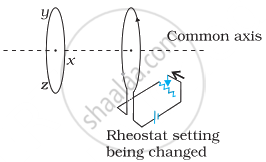
Two circular loops of equal radii are placed coaxially at some separation. The first is cut and a battery is inserted in between to drive a current in it. The current changes slightly because of the variation in resistance with temperature. During this period, the two loops _______________ .
A bar magnet is moved along the axis of a copper ring placed far away from the magnet. Looking from the side of the magnet, an anticlockwise current is found to be induced in the ring. Which of the following may be true?
(a) The south pole faces the ring and the magnet moves towards it.
(b) The north pole faces the ring and the magnet moves towards it.
(c) The south pole faces the ring and the magnet moves away from it.
(d) The north pole faces the ring and the magnet moves away from it.
Energy dissipate in LCR circuit in
Predict the direction of induced current in the situation described by the following figure.
Which laws determine the magnitude of an induced EMF?
Which apparatus is used to observe the induced current when a magnet moves relative to a coil?
When the N-pole moves towards the coil, which induced current direction and near-face pole are observed?
What would happen to the magnet if an induced South pole attracted an approaching N-pole without external effort?
For a rectangular loop entering an out-of-page magnetic field, what is the induced current direction and path?
