Advertisements
Advertisements
प्रश्न
State Lenz's law. Illustrate, by giving an example, how this law helps in predicting the direction of the current in a loop in the presence of a changing magnetic flux.
Advertisements
उत्तर
(i)According to Lenz's law, the polarity of emf induced in the coil always opposes the change in the magnetic flux responsible for production of induced emf.
(ii) Lenz's law is used to determine the direction of current induced in the closed circuit. Let us consider an example to illustrate it. When a north pole of a bar magnet is brought closer to a coil, as shown in figure, the amount of magnetic flux linked with the coil increases. So, the current induced in the coil is directed such that it opposes this change in magnetic flux responsible for production of induced current, which is possible only when the current induced in the coil is in anticlockwise direction of the observer on the side of the magnet.
Similarly, the direction of induced current can be found when north pole of bar magnet is moved away from the coil. As the magnetic flux in this case decreases, the induced current is in the clockwise direction.

 \


APPEARS IN
संबंधित प्रश्न
Predict the direction of induced current in the situation described by the following figure.

A short magnet is moved along the axis of a conducting loop. Show that the loop repels the magnet if the magnet is approaching the loop and attracts the magnet if it is going away from the loop.
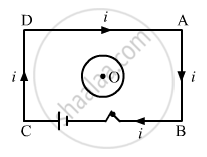
Consider the situation shown in figure. If the closed loop is completely enclosed in the circuit containing the switch, the closed loop will show _______________ .
Explain, with the help of a suitable example, how we can show that Lenz's law is a consequence of the principle of conservation of energy.
Lenz’s law is a consequence of the law of conservation of ______.
A solenoid is connected to a battery so that a steady current flows through it. If an iron core is inserted into the solenoid, will the current increase or decrease? Explain.
What happens whenever the magnetic flux through a closed circuit changes?
What is observed when the magnet is held stationary near the coil?
When the N-pole moves away from the coil, what happens to the flux and galvanometer?
What would happen to the magnet if an induced South pole attracted an approaching N-pole without external effort?
