Advertisements
Advertisements
प्रश्न
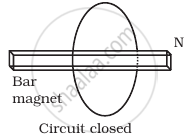
Consider a magnet surrounded by a wire with an on/off switch S (Figure). If the switch is thrown from the off position (open circuit) to the on position (closed circuit), will a current flow in the circuit? Explain.

Advertisements
उत्तर
Whenever the number of magnetic lines of force (magnetic flux) passing through a circuit changes an emf is produced in the circuit called induced emf. The induced emf persists only as long as there is a change or cutting of flux. The induced emf is given by rate of change of magnetic flux linked with the circuit i.e, `e= (- dphi)/(dt)`. so flux linked will change when either magnetic field, area or the angle between B and A changes.
If the switch is closed, the circuit will complete. But to induce emf in the circuit, we need:
- A changing magnetic field, but the bar magnet is stationary so it is not possible in this situation.
- A changing area is also not possible because area is also constant as coil is not expanding or compressed.
- Angle between B bar and A bar changes, which is also not possible in this situation because orientation of bar magnet and coil is fixed.
Thus, no change in magnetic flux linked with coil occur, hence no electromotive force is induced in the coil and hence no current will flow in the circuit.
APPEARS IN
संबंधित प्रश्न
State Lenz's law. Illustrate, by giving an example, how this law helps in predicting the direction of the current in a loop in the presence of a changing magnetic flux.
Predict the direction of induced current in the situation described by the following figure.

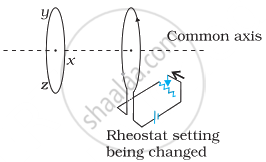
The battery discussed in the previous question is suddenly disconnected. Is a current induced in the other loop? If yes, when does it start and when does it end? Do the loops attract each other or repel?
A bar magnet is released from rest along the axis of a very long, vertical copper tube. After some time the magnet ____________ .
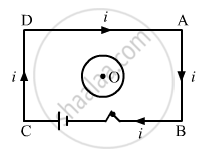
Consider the situation shown in figure. If the closed loop is completely enclosed in the circuit containing the switch, the closed loop will show _______________ .
Which of the following statements is not correct?
Young's modulus for aluminium is 7 × 10¹⁰ Pa. The force needed to stretch an aluminium wire of diameter 2 mm and length 800 mm by 1 mm is ______.
A bar magnet is dropped through a copper ring acceleration of magnet is
Lenz's law gives ______
A solenoid is connected to a battery so that a steady current flows through it. If an iron core is inserted into the solenoid, will the current increase or decrease? Explain.
Predict the direction of induced current in the situation described by the following figure.
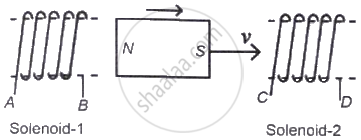
In the diagram given below, a strong bar magnet is moving towards solenoid-2 from solenoid-1. The direction of induced current in solenoid-1 and that in solenoid-2, respectively, are through the directions:
When the N-pole moves towards the coil, what happens to the flux and galvanometer?
When the N-pole moves away from the coil, what happens to the flux and galvanometer?
When the N-pole moves away from the coil, which induced current direction and near-face pole are observed?
What would happen to the magnet if an induced South pole attracted an approaching N-pole without external effort?
How does an induced field oppose an increase in magnetic flux?
In what sense does Lenz's law behave like electromagnetic inertia?
