Advertisements
Advertisements
प्रश्न
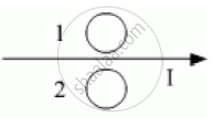
Predict the directions of induced currents in metal rings 1 and 2 lying in the same plane where current I in the wire is increasing steadily.
Advertisements
उत्तर
Using Lenz’s law we can predict the direction of induced current in both the rings. Induce current oppose the cause of increasing of magnetic flux. So,

It will be clockwise in ring 1 and anticlockwise in ring 2
APPEARS IN
संबंधित प्रश्न
A bar magnet is moved in the direction indicated by the arrow between two coils PQ and CD. Predict the directions of induced current in each coil.

Lenz’s law is a consequence of the law of conservation of ______.
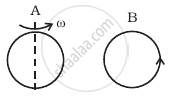
Same as problem 4 except the coil A is made to rotate about a vertical axis (figure). No current flows in B if A is at rest. The current in coil A, when the current in B (at t = 0) is counterclockwise and the coil A is as shown at this instant, t = 0, is ______.
Predict the direction of induced current in the situation described by the following figure.
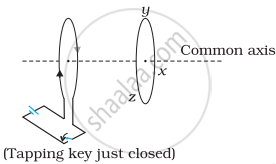
Predict the direction of induced current in the situation described by the following figure.
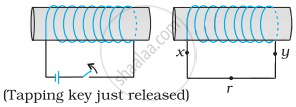
Predict the direction of induced current in the situation described by the following figure.

Which apparatus is used to observe the induced current when a magnet moves relative to a coil?
When the N-pole moves towards the coil, what happens to the flux and galvanometer?
When the N-pole moves towards the coil, which induced current direction and near-face pole are observed?
In what sense does Lenz's law behave like electromagnetic inertia?
