Advertisements
Advertisements
प्रश्न
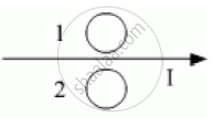
Predict the directions of induced currents in metal rings 1 and 2 lying in the same plane where current I in the wire is increasing steadily.
Advertisements
उत्तर
Using Lenz’s law we can predict the direction of induced current in both the rings. Induce current oppose the cause of increasing of magnetic flux. So,

It will be clockwise in ring 1 and anticlockwise in ring 2
APPEARS IN
संबंधित प्रश्न
Predict the direction of induced current in metal rings 1 and 2 when current I in the wire is steadily decreasing?
A short magnet is moved along the axis of a conducting loop. Show that the loop repels the magnet if the magnet is approaching the loop and attracts the magnet if it is going away from the loop.
Two circular loops of equal radii are placed coaxially at some separation. The first is cut and a battery is inserted in between to drive a current in it. The current changes slightly because of the variation in resistance with temperature. During this period, the two loops _______________ .
Explain, with the help of a suitable example, how we can show that Lenz's law is a consequence of the principle of conservation of energy.
Lenz’s law is a consequence of the law of conservation of ______.
Which of the following statements is not correct?
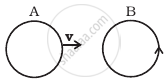
There are two coils A and B as shown in figure. A current starts flowing in B as shown, when A is moved towards B and stops when A stops moving. The current in A is counterclockwise. B is kept stationary when A moves. We can infer that ______.
A coil is suspended in a uniform magnetic field, with the plane of the coil parallel to the magnetic lines of force. When a current is passed through the coil it starts oscillating: It is very difficult to stop. But if an aluminium plate is placed near to the coil, it stops. This is due to:
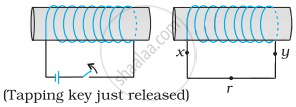
Predict the direction of induced current in the situation described by the following figure.
Which expression incorporates Lenz's law into Faraday's law?
