Advertisements
Advertisements
प्रश्न
Describe a simple experiment (or activity) to show that the polarity of emf induced in a coil is always such that it tends to produce a current which opposes the change of magnetic flux that produces it.
Advertisements
उत्तर
Lenz law: According to Lenz's law, the polarity of the induced emf is such that it opposes a change in magnetic flux responsible for its production.
Activity:

When the north pole of a bar magnet is pushed towards the coil, the amount of magnetic flux linked with the coil increases. Current is induced in the coil in from a direction such that it opposes the increase in magnetic flux. This is possible only when the current induced in the coil is in anti-clockwise direction, with respect to an observer. The magnetic moment `vecM` associated with this induced emf has north polarity, towards the north pole of the approaching bar magnet.
Similarly, when the north pole of the bar magnet is moved away from the coil, the magnetic flux linked with the coil decreases. To counter this decrease in magnetic flux, current is induced in the coil in clockwise direction so that its south pole faces the receding north pole of the bar magnet. This would result in an attractive force which opposes the motion of the magnet and the corresponding decrease in magnetic flux.
APPEARS IN
संबंधित प्रश्न
A pivoted aluminium bar falls much more slowly through a small region containing a magnetic field than a similar bar of an insulating material. Explain.
Explain, with the help of a suitable example, how we can show that Lenz's law is a consequence of the principle of conservation of energy.
Young's modulus for aluminium is 7 × 10¹⁰ Pa. The force needed to stretch an aluminium wire of diameter 2 mm and length 800 mm by 1 mm is ______.
Energy dissipate in LCR circuit in
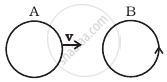
There are two coils A and B as shown in figure. A current starts flowing in B as shown, when A is moved towards B and stops when A stops moving. The current in A is counterclockwise. B is kept stationary when A moves. We can infer that ______.
Consider a metal ring kept on top of a fixed solenoid (say on a carboard) (Figure). The centre of the ring coincides with the axis of the solenoid. If the current is suddenly switched on, the metal ring jumps up. Explain

When the N-pole moves towards the coil, which induced current direction and near-face pole are observed?
How does an induced field oppose an increase in magnetic flux?
What happens as the rate of change of magnetic flux becomes greater?
A rectangular loop moves into a region where the magnetic field points out of the page. What happens to the flux through the loop?
