Advertisements
Advertisements
प्रश्न
A beam of unpolarised light is incident on a glass-air interface. Show, using a suitable ray diagram, that light reflected from the interface is totally polarised, when μ = tan iB, where μ is the refractive index of glass with respect to air and iB is the Brewster's angle.
Advertisements
उत्तर
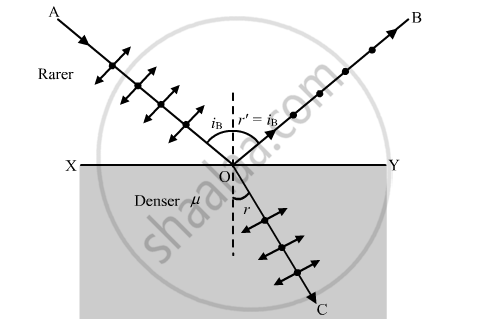
When unpolarised light is incident on the glass-air interface at Brewster angle iB, then reflected light is totally polarised. This is called Brewster's Law.
When light is incident at Brewster angle, the reflected component OB and the refracted component OC are mutually perpendicular to each other.
From the figure, we have
∠BOY + ∠YOC = 900
( 900 − iB ) + ( 900 − r ) = 900
where, r is angle of refraction
900 − iB = r
According to the Snell's law:
`mu=sini/sinr`
i = iB and r = (900 − iB)
`mu=sini_B/sin(90^@-i_B)=sini_B/cosi_B`
μ =tan iB
Hence proved.
APPEARS IN
संबंधित प्रश्न
With the help of neat diagram, explain how non-polar dielectric material is polarised in external electric field of increasing intensity. Define polarisation in dielectrics.
Why does an unpolarised light incident on a polaroid get linearly polarised ?
How does one demonstrate, using a suitable diagram, that unpolarised light when passed through a Polaroid gets polarised?
The refractive indices of water for red and violet colours are 1.325 and 1.334 respectively.
Find the difference between the velocities of rays for these two colours in water. (c = 3 × 10⁸ m/s)
A beam of light is incident at the polarizing angle of 35° on a certain glass plate. The refractive index of the glass plate is :
The transverse nature of light is shown in ______.
What is polarisation?
Mention the types of optically active crystals with example.
Which of the following phenomena is not common to sound and light waves?
For the same objective, find the ratio of the least separation between two points to be distinguished by a microscope for light of 5000 Å and electrons accelerated through 100 V used as the illuminating substance.
