Advertisements
Advertisements
प्रश्न
Draw a schematic sketch of an ac generator describing its basic elements. State briefly its working principle. Show a plot of variation of
(i) Magnetic flux and
(ii) Alternating emf versus time generated by a loop of wire rotating in a magnetic field.
Advertisements
उत्तर
Principle − Based on the phenomenon of electromagnetic induction.
Construction:
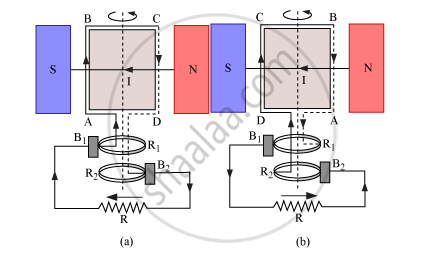
Main parts of an ac generator:
Armature − The rectangular coil ABCD
Filed Magnets − Two pole pieces of a strong electromagnet
Slip Rings − The ends of the coil ABCD are connected to two hollow metallic rings R1 and R2.
Brushes − B1 and B2 are two flexible metal plates or carbon rods. They are fixed and are kept in tight contact with R1 and R2, respectively.
Working − As the armature coil is rotated in the magnetic field, angle θ between the field and the normal to the coil changes continuously. Therefore, magnetic flux linked with the coil changes and an emf is induced in the coil. According to Fleming’s right hand rule, current is induced from A to B in AB and from C to D in CD. In the external circuit, current flows from B2 to B1.
To calculate the magnitude of emf induced:
Suppose A → Area of each turn of the coil
N → Number of turns in the coil
`vecB`→ Strength of the magnetic field
θ → Angle which normal to the coil makes with `vecB` at any instant t
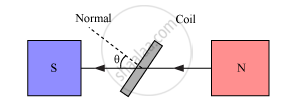
∴ Magnetic flux linked with the coil in this position is given by,
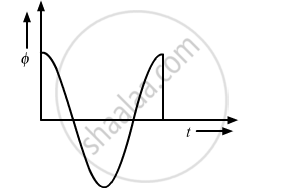
`phi=N(vecB.vecA)=NBAcostheta=NBAcos `
Where, ‘ω’ is angular velocity of the coil
Graph between magnetic flux and time, according to equation (i), is shown below:
As the coil rotates, angle θ changes. Therefore, magnetic flux Φ linked with the coil changes and an emf is induced in the coil. At this instant t, if e is the emf induced in the coil, then
`e=(dtheta)/dt=-d/dt(NABcos`
`=-NABd/dt(cos `
=-NAB(-sin ωt)ω
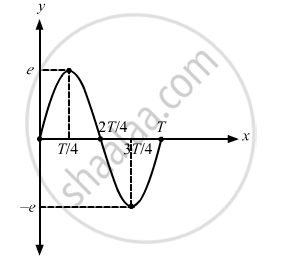
∴ e = NAB ω sin ωt
The graph between alternating emf versus time is shown below:
APPEARS IN
संबंधित प्रश्न
Ram is a student of class X in a village school. His uncle gifted him a bicycle with a dynamo fitted in it. He was very excited to get it. While cycling during night, he could light the bulb and see the objects on the road. He, however, did not know how this device works. he asked this question to his teacher. The teacher considered it an opportunity to explain the working to the whole class.
Answer the following questions:
(a) State the principle and working of a dynamo.
(b) Write two values each displayed by Ram and his school teacher.
A square loop MNOP of side 20 cm is placed horizontally in a uniform magnetic field acting vertically downwards as shown in the figure. The loop is pulled with a constant velocity of 20 cm s−1 till it goes out of the field.
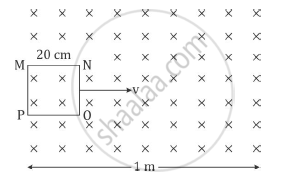
(i) Depict the direction of the induced current in the loop as it goes out of the field. For how long would the current in the loop persist?
(ii) Plot a graph showing the variation of magnetic flux and induced emf as a function of time.
Whenever the magnetic flux linked with an electric circuit changes, an emf is induced in the circuit. This is called ______.
Two inductors of inductance L each are connected in series with the opposite? magnetic fluxes. The resultant inductance is ______.
The magnetic flux linked with the coil (in Weber) is given by the equation- Փ = 5t2 + 3t + 16. The induced EMF in the coil at time, t = 4 will be ______.
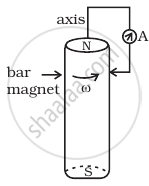
A cylindrical bar magnet is rotated about its axis (Figure). A wire is connected from the axis and is made to touch the cylindrical surface through a contact. Then
Consider a closed loop C in a magnetic field (Figure). The flux passing through the loop is defined by choosing a surface whose edge coincides with the loop and using the formula φ = B1.dA1 + B2.dA2 +... Now if we chose two different surfaces S1 and S2 having C as their edge, would we get the same answer for flux. Jusity your answer.

How is a surface handled when calculating flux through a non-uniform magnetic field or a curved surface?
What is the flux when the magnetic field is at an angle \[\theta\] to the area vector?
Which expression is Gauss's Law for Magnetism?
