Advertisements
Advertisements
प्रश्न
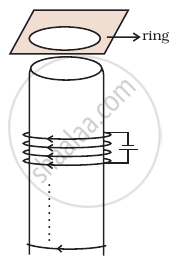
Consider a metal ring kept (supported by a cardboard) on top of a fixed solenoid carrying a current I (Figure). The centre of the ring coincides with the axis of the solenoid. If the current in the solenoid is switched off, what will happen to the ring?
Advertisements
उत्तर
This problem is based on Lenz’s law and according to this law, the direction of induced emf or current in a circuit is such as to oppose the cause that produces it.
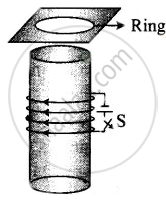
When the switch is opened, current in the circuit of solenoid stops flowing. Initially, there is some magnetic flux linked with the solenoid and now if current in the circuit stops, the magnetic flux falls to zero or we can say that magnetic flux linked through the ring decreases.
According to Lenz’s law, this decrease in flux will be opposed and the ring experiences downward force toward the solenoid.
This happen because the current decrease will cause a clockwise current (as seen from the top in the ring in figure) to increase the decreasing flux. This can be done if the direction of induced magnetic field is same as that of solenoid. This makes the opposite sense of the flow of current in the ring (when viewed from the bottom of the ring) and solenoid form opposite magnetic poles in front of each other.
Hence, they will -attract each other but as ring is placed at the cardboard it could not be able to move downward.
APPEARS IN
संबंधित प्रश्न
State Lenz's law. Illustrate, by giving an example, how this law helps in predicting the direction of the current in a loop in the presence of a changing magnetic flux.
Predict the direction of induced current in the situation described by the following figure.

The battery discussed in the previous question is suddenly disconnected. Is a current induced in the other loop? If yes, when does it start and when does it end? Do the loops attract each other or repel?
A bar magnet is released from rest along the axis of a very long, vertical copper tube. After some time the magnet ____________ .
Consider the situation shown in figure. If the closed loop is completely enclosed in the circuit containing the switch, the closed loop will show _______________ .
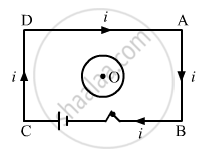
Explain, with the help of a suitable example, how we can show that Lenz's law is a consequence of the principle of conservation of energy.
Young's modulus for aluminium is 7 × 10¹⁰ Pa. The force needed to stretch an aluminium wire of diameter 2 mm and length 800 mm by 1 mm is ______.
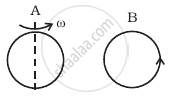
Same as problem 4 except the coil A is made to rotate about a vertical axis (figure). No current flows in B if A is at rest. The current in coil A, when the current in B (at t = 0) is counterclockwise and the coil A is as shown at this instant, t = 0, is ______.
A solenoid is connected to a battery so that a steady current flows through it. If an iron core is inserted into the solenoid, will the current increase or decrease? Explain.
A metallic ring of mass m and radius `l` (ring being horizontal) is falling under gravity in a region having a magnetic field. If z is the vertical direction, the z-component of magnetic field is Bz = Bo (1 + λz). If R is the resistance of the ring and if the ring falls with a velocity v, find the energy lost in the resistance. If the ring has reached a constant velocity, use the conservation of energy to determine v in terms of m, B, λ and acceleration due to gravity g.
Predict the direction of induced current in the situation described by the following figure.
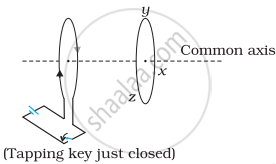
Predict the direction of induced current in the situation described by the following figure.

What do Faraday's laws and Lenz's law form together?
When the N-pole moves towards the coil, which induced current direction and near-face pole are observed?
What does the magnetic pole created on the near face of the coil oppose when a magnet moves?
Suppose an induced current aided the flux change as an N-pole approached a coil. Which pole would form on the near face?
How does an induced field oppose an increase in magnetic flux?
What is the induced current path for an irregular loop moving out of an out-of-page magnetic field?
