Advertisements
Advertisements
Question
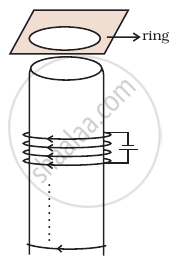
Consider a metal ring kept (supported by a cardboard) on top of a fixed solenoid carrying a current I (Figure). The centre of the ring coincides with the axis of the solenoid. If the current in the solenoid is switched off, what will happen to the ring?
Advertisements
Solution
This problem is based on Lenz’s law and according to this law, the direction of induced emf or current in a circuit is such as to oppose the cause that produces it.
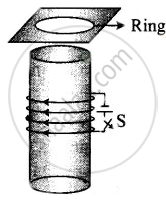
When the switch is opened, current in the circuit of solenoid stops flowing. Initially, there is some magnetic flux linked with the solenoid and now if current in the circuit stops, the magnetic flux falls to zero or we can say that magnetic flux linked through the ring decreases.
According to Lenz’s law, this decrease in flux will be opposed and the ring experiences downward force toward the solenoid.
This happen because the current decrease will cause a clockwise current (as seen from the top in the ring in figure) to increase the decreasing flux. This can be done if the direction of induced magnetic field is same as that of solenoid. This makes the opposite sense of the flow of current in the ring (when viewed from the bottom of the ring) and solenoid form opposite magnetic poles in front of each other.
Hence, they will -attract each other but as ring is placed at the cardboard it could not be able to move downward.
APPEARS IN
RELATED QUESTIONS
State Lenz's law. Illustrate, by giving an example, how this law helps in predicting the direction of the current in a loop in the presence of a changing magnetic flux.
Predict the direction of induced current in the situation described by the following figure.

Use Lenz’s law to determine the direction of induced current in the situation described by the figure:
A wire of irregular shape turning into a circular shape.

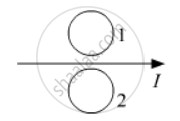
What is the direction of induced currents in metal rings 1 and 2 when current I in the wire is increasing steadily?
Show that Lenz's law is a consequence of conservation of energy.
A bar magnet is moved in the direction indicated by the arrow between two coils PQ and CD. Predict the directions of induced current in each coil.

A short magnet is moved along the axis of a conducting loop. Show that the loop repels the magnet if the magnet is approaching the loop and attracts the magnet if it is going away from the loop.
The battery discussed in the previous question is suddenly disconnected. Is a current induced in the other loop? If yes, when does it start and when does it end? Do the loops attract each other or repel?
A bar magnet is moved along the axis of a copper ring placed far away from the magnet. Looking from the side of the magnet, an anticlockwise current is found to be induced in the ring. Which of the following may be true?
(a) The south pole faces the ring and the magnet moves towards it.
(b) The north pole faces the ring and the magnet moves towards it.
(c) The south pole faces the ring and the magnet moves away from it.
(d) The north pole faces the ring and the magnet moves away from it.
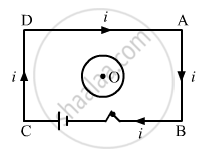
Consider the situation shown in figure. If the closed loop is completely enclosed in the circuit containing the switch, the closed loop will show _______________ .
Explain, with the help of a suitable example, how we can show that Lenz's law is a consequence of the principle of conservation of energy.
Lenz’s law is a consequence of the law of conservation of ______.
Young's modulus for aluminium is 7 × 10¹⁰ Pa. The force needed to stretch an aluminium wire of diameter 2 mm and length 800 mm by 1 mm is ______.
For a coil having L = 2 mH, current flows at the rate of 10-3 AIS. The e.m.f induced is
Who formulated Lenz's law in 1834?
When the N-pole moves away from the coil, what happens to the flux and galvanometer?
How does an induced field oppose a decrease in magnetic flux?
For a triangular loop leaving an out-of-page magnetic field, what is the induced current direction and path?
