Advertisements
Advertisements
प्रश्न
A bar magnet is moved along the axis of a copper ring placed far away from the magnet. Looking from the side of the magnet, an anticlockwise current is found to be induced in the ring. Which of the following may be true?
(a) The south pole faces the ring and the magnet moves towards it.
(b) The north pole faces the ring and the magnet moves towards it.
(c) The south pole faces the ring and the magnet moves away from it.
(d) The north pole faces the ring and the magnet moves away from it.
Advertisements
उत्तर
(b) The north pole faces the ring and the magnet moves towards it.
(c) The south pole faces the ring and the magnet moves away from it.
It can be observed that the induced current is in anti-clockwise direction. So, the magnetic field induced in the copper ring is towards the observer.
According to Lenz's law, the current induced in a circuit due to a change in the magnetic flux is in such direction so as to oppose the change in flux.
Two cases are possible:-
(1) The magnetic flux is increasing in the direction from the observer to the circular coil.
(2) The magnetic flux is decreasing in the direction from the coil to the observer.
So, from the above mentioned points, the following conclusions can be made:-
1. The south pole faces the ring and the magnet moves away from it.
2. The north pole faces the ring and the magnet moves towards it.
APPEARS IN
संबंधित प्रश्न
State Lenz's law. Illustrate, by giving an example, how this law helps in predicting the direction of the current in a loop in the presence of a changing magnetic flux.
Predict the direction of induced current in the situation described by the following figure.

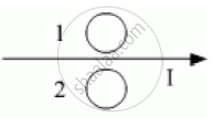
What is the direction of induced currents in metal rings 1 and 2 when current I in the wire is increasing steadily?
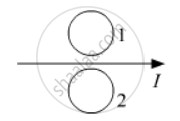
Predict the directions of induced currents in metal rings 1 and 2 lying in the same plane where current I in the wire is increasing steadily.
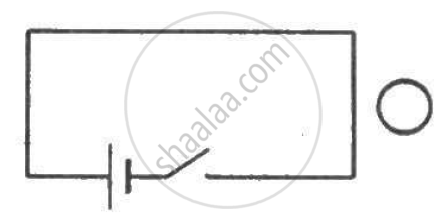
Consider the situation shown in figure. If the switch is closed and after some time it is opened again, the closed loop will show ____________ .
Explain, with the help of a suitable example, how we can show that Lenz's law is a consequence of the principle of conservation of energy.
Which of the following statements is not correct?
Energy dissipate in LCR circuit in
Lenz's law gives ______
A wire in the form of a tightly wound solenoid is connected to a DC source, and carries a current. If the coil is stretched so that there are gaps between successive elements of the spiral coil, will the current increase or decrease? Explain.
A solenoid is connected to a battery so that a steady current flows through it. If an iron core is inserted into the solenoid, will the current increase or decrease? Explain.
A conducting wire XY of mass m and neglibile resistance slides smoothly on two parallel conducting wires as shown in figure. The closed circuit has a resistance R due to AC. AB and CD are perfect conductors. There is a ˆ. magnetic field `B = B(t)hatk`.
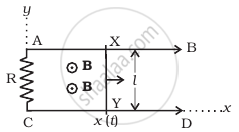
- Write down equation for the acceleration of the wire XY.
- If B is independent of time, obtain v(t) , assuming v(0) = u0.
- For (b), show that the decrease in kinetic energy of XY equals the heat lost in R.
A long solenoid ‘S’ has ‘n’ turns per meter, with diameter ‘a’. At the centre of this coil we place a smaller coil of ‘N’ turns and diameter ‘b’ (where b < a). If the current in the solenoid increases linearly, with time, what is the induced emf appearing in the smaller coil. Plot graph showing nature of variation in emf, if current varies as a function of mt2 + C.
What happens whenever the magnetic flux through a closed circuit changes?
Which laws determine the magnitude of an induced EMF?
When the N-pole moves towards the coil, which induced current direction and near-face pole are observed?
When the N-pole moves away from the coil, which induced current direction and near-face pole are observed?
For a rectangular loop entering an out-of-page magnetic field, what is the induced current direction and path?
What is the induced current path for an irregular loop moving out of an out-of-page magnetic field?
