Advertisements
Advertisements
प्रश्न
Explain, with the help of a suitable example, how we can show that Lenz's law is a consequence of the principle of conservation of energy.
Advertisements
उत्तर
Lenz's law states that the polarity of induced emf is such that it tends to produce a current which opposes the change in magnetic flux that produced it. The negative sign shown in equation `epsilon = -(d Ø_"g")/(d"t")` represents this effect.
Conservation of energy :

Suppose that the induced current was in the direction opposite to the one depicted in Fig. (a). In that case, the South-pole due to the induced current will face the approaching North-pole of the magnet. The bar magnet will then be attracted to the coil at an ever-increasing acceleration. A gentle push on the magnet will initiate the process and its velocity and kinetic energy will continuously increase without expending any energy. If this can happen, one could construct a perpetual-motion machine by a suitable arrangement. This violates the law of conservation of energy and hence can not happen. Now consider the correct case shown in Fig. (a). In this situation, the bar magnet experiences a repulsive force due to the induced current. Therefore, a person has to do work in moving the magnet. Where does the energy spent by the person go? This energy is dissipated by Joule heating produced by the induced current.
APPEARS IN
संबंधित प्रश्न
State Lenz's law. Illustrate, by giving an example, how this law helps in predicting the direction of the current in a loop in the presence of a changing magnetic flux.
Describe a simple experiment (or activity) to show that the polarity of emf induced in a coil is always such that it tends to produce a current which opposes the change of magnetic flux that produces it.
Predict the direction of induced current in a metal ring when the ring is moved towards a straight conductor with constant speed v. The conductor is carrying current I in the direction shown in the figure.
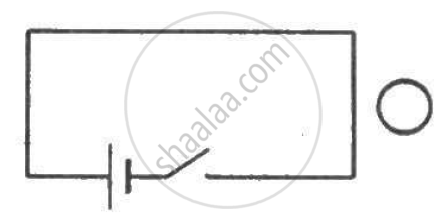
Consider the situation shown in figure. If the switch is closed and after some time it is opened again, the closed loop will show ____________ .
Young's modulus for aluminium is 7 × 10¹⁰ Pa. The force needed to stretch an aluminium wire of diameter 2 mm and length 800 mm by 1 mm is ______.
Predict the direction of induced current in the situation described by the following figure.

Use Lenz’s law to determine the direction of induced current in the situation described by the figure.
A circular loop being deformed into a narrow straight wire.

Which expression incorporates Lenz's law into Faraday's law?
What does the magnetic pole created on the near face of the coil oppose when a magnet moves?
Why must continuous mechanical work be supplied to an AC generator?
