Advertisements
Advertisements
प्रश्न
Establish the fact that the relative motion between the coil and the magnet induces an emf in the coil of a closed circuit.
Advertisements
उत्तर
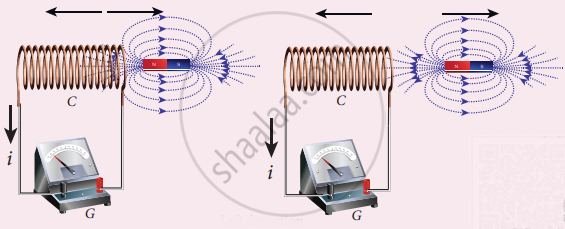
- In first experiment when bar magnet is placed close to the coil, magnetic lines pass through coil, the magnetic flux in coil increases and emf is induced hence electric current flows in the circuit.
- At the same time when they recede away from one another magnetic flux decreases emf is induced in opposite direction. Current flows in opposite direction. So there is a deflection in the galvanometer.
- In the second experiment, when the primary circuit is open, no electric current flows in it, magnetic flux linked with the secondary coil is zero.

(a) Right deflection - When primary circuit is closed, increasing current produces a magnetic field. So magnetic flux linked with coil increases. This induced current in the secondary coil.
(a) Left deflection - When the primary circuit is broken, decreasing primary current induces a current in the secondary coil but in opposite direction. So there is a deflection in Galvanorneter.
(a)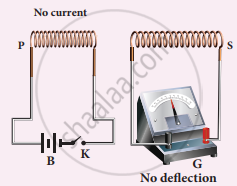
(b)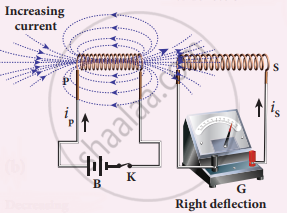
(c)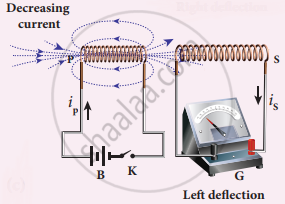
APPEARS IN
संबंधित प्रश्न
The most suitable material for making the core of an electromagnet is:
(a) soft iron
(b) brass
(c) aluminium
(d) steel
What do you understand by the term "electromagnetic induction"? Explain with the help of a diagram.
In which of the following case does the electromagnetic induction occur?
A loop of wire is held near a magnet.
Consider the energy density in a solenoid at its centre and that near its ends. Which of the two is greater?
Answer the following:
State the principles of the electric motor and electric generator.
Fleming's left hand rule : electric current : : Fleming's right hand rule : _______
The charge will flow through a galvanometer of resistance 200Ω connected to a 400Ω circular coil of 1000 turns wound on a wooden stick 20 mm in diameter, if a magnetic field B = 0.012 T parallel to the axis of the stick decreased suddenly to zero, is near ______.
What did Faraday show in 1831?
What is a solenoid?
What is a changing magnetic field?
