Advertisements
Advertisements
प्रश्न
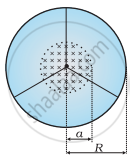
A line charge λ per unit length is lodged uniformly onto the rim of a wheel of mass M and radius R. The wheel has light non-conducting spokes and is free to rotate without friction about its axis (Figure). A uniform magnetic field extends over a circular region within the rim. It is given by,
B = − B0 k (r ≤ a; a < R)
= 0 (otherwise)
What is the angular velocity of the wheel after the field is suddenly switched off?
Advertisements
उत्तर
Line charge per unit length = λ = `"Total charge"/"Length"` = `"Q"/(2π"r")`
Where,
r = Distance of the point within the wheel
Mass of the wheel = M
Radius of the wheel = R
Magnetic field, `vec"B" = -"B"_0hat"k"`
At distance r,themagnetic force is balanced by the centripetal force i.e.,
`"BQv" = ("mv"^2)/"r"`
Where
v = linear velocity of the wheel
∴ `"B"2pi"r"lambda = ("Mv")/"r"`
`"v" = ("B"2pilambda"r"^2)/"M"`
∴ Angular velocity, `omega = "v"/"r" = ("B"2pilambda"r"^2)/("MR")`
For r ≤ and a < R, we get:
`omega = -(2pi"B""aa"^2lambda)/("MR")hat"k"`
APPEARS IN
संबंधित प्रश्न
The magnetic flux through a loop varies according to the relation Φ = 8t2 + 6t + C, where ‘C’ is constant, 'Φ' is in milliweber and 't' is in second. What is the magnitude of induced e.m.f. in the loop at t = 2 seconds.
How does an electromagnet differ forma permanent magnet?
What is an electromagnet? Describe the construction and working of an electromagnet with the help of a labelled diagram.
Write some of the important uses of electromagnets.
Name and state the law which determines the direction of induced current.
or
State Fleming’s right-hand rule.
The coil of a moving-coil galvanometer keeps on oscillating for a long time if it is deflected and released. If the ends of the coil are connected together, the oscillation stops at once. Explain.
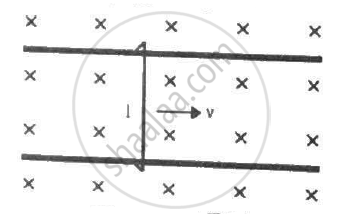
Figure shows a wire sliding on two parallel, conducting rails placed at a separation l. A magnetic field B exists in a direction perpendicular to the plane of the rails. What force is necessary to keep the wire moving at a constant velocity v?
Draw a simple labeled diagram of a step-up transformer.
Draw and label the diagram of a simple D.C. motor.
(a) Explain the rotation of the coil, giving a reason for your answer.
(b) How can you reverse the direction of rotation of the armature?
(c) How can you increase the speed of rotation of the motor?
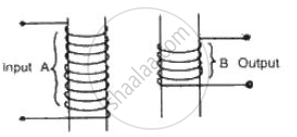
Complete the following diagram of a transformer and name the parts labeled A and B. Name the part you have drawn to complete the diagram . What is the material of this part? In this transformer a step-up or step-down? Why?
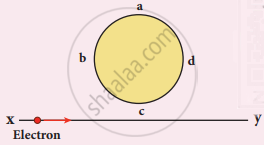
An electron moves on a straight-line path XY as shown in the figure. The coil abcd is adjacent to the path of the electron. What will be the direction of the current, if any, induced in the coil?
A coil of 200 turns carries a current of 4 A. If the magnetic flux through the coil is 6 x 10⁻⁵ Wb, find the magnetic energy stored in the medium surrounding the coil.
There is a uniform magnetic field directed perpendicular and into the plane of the paper. An irregular shaped conducting loop is slowly changing into a circular loop in the plane of the paper. Then ______.
A conducting bar of length L is free to slide on two parallel conducting rails as shown in the figure

Two resistors R1 and R2 are connected across the ends of the rails. There is a uniform magnetic field `vec"B"` pointing into the page. An external agent pulls the bar to the left at a constant speed v. The correct statement about the directions of induced currents I1 and I2 flowing through R1 and R2 respectively is:
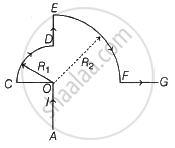
In the current carrying conductor (AOCDEFG) as shown, the magnetic induction at point O is ______.
(R1 and R2 are radii of CD and EF respectively. l = current in the loop, μ0 = permeability of free space)
What is produced when a magnet moves towards or away from a coil?
Which device used for producing electricity works on electromagnetic induction?
Which type of motor works on electromagnetic induction?
